Showing posts with label hugo weaving. Show all posts

Thursday, 19 December 2013

A Life in Six Stars (A Cloud Atlas review)

Poster by Tumblr user WatsonPrime.
"The eternal hourglass of existence is turned upside down again and again, and you with it, you speck of dust!"
Friedrich Nietszche, The Gay Science
The universe begins to look more like a great thought than a great machine.
James Hopwood Jeans 

I. Dogs of Diogenes


Most of the people who know me, or who just take a glance at my Facebook timeline, would tell you I'm cynical. I question what's presented, tear it open, and try to divine the truth from its entrails. In truth, it's a side of me I'm actively trying to fight, or at least keep on a leash. To be a cynic nowadays means to be jaded, to have little to no faith in humanity. This isn't, of course, how it used to be. The philosophy of Cynicism, the kind espoused by Antisthenes and Diogenes and the like, espoused virtue above all else, prizing a free happy life as the greatest thing one could possibly have.

I wouldn't say being a Cynic, rather than a small-c cynic, appeals much more to me. Being a Cynic sounds like going straight-edge, or like following a warrior's code; nothing is more important than virtue. Not money, not power, not hygiene, not reputation, not society. The name itself comes from the Ancient Greek "kynikos", meaning "dog-like", and initially lent itself to insults; Cynics were frequently called dogs for rejecting societal norms and living in the streets, though Diogenes took it as a compliment: other dogs bite their enemies, I bite my friends to save them. To be a dog meant being free and loyal to your cause.


At some point down the line, Cynicism lost the privilege of a capital letter, moving from evangelical crusader for happiness to bitter loner on the outer fringes of society. And while small-c cynics can certainly have an eye for improving life and human interaction - that's probably what fuels our most well-known grumpy bastards - all too often, that noble goal gets lost in favour of being perpetually disillusioned and getting a sense of grim satisfaction when things go tits-up. It's trendy to be cynical. It's even bled through into our entertainment, with the heroes of Western fiction - films, video games, TV, comics - becoming increasingly harder and sociopathic, to better appeal to our power fantasies. Even when they "win", it's a Pyrrhic victory. Man of Steel ends with Superman killing the last survivors of Krypton. John McClane is no longer an Everyman cop who can get hurt, he's a Category 5 hurricane made of bullets.

Too many of us are cynics.

II. From Heaven to the Gutter


Talking about Cloud Atlas really is like dancing about architecture. The original novel by David Mitchell has a narrative structure like a Chinese puzzle box, with six different stories in six different styles nestled within each other, interrupting one another before reaching the middle, with each one being wrapped up in succession. These stories are, in order:
  1. American lawyer Adam Ewing (Jim Sturgess) travelling across the Pacific Ocean in 1849, saving a runaway Polynesian slave (David Gyasi) from death even as he slowly succumbs to illness from a parasite. His adventures are chronicled in a journal, read by...
  2. English musician Robert Frobisher (Ben Whishaw), disgraced son of a wealthy family, as he flees to Edinburgh (Belgium in the book), to become the apprentice of renowned composer Vyvyan Ayrs (Jim Broadbent) and prove himself as a musician. He writes about his experiences to his lover Sixsmith (James D'Arcy), who retains the letters well in to old age, which eventually fall into the hands of...
  3. Investigative journalist Luisa Rey (Halle Berry), who is tipped off by an aged Sixsmith about foul play involving a new nuclear reactor being developed in San Francisco during the 1970s. Key figures in the reactor's development turn up dead, and time's running out on Rey to figure out the mystery. Her story becomes the basis of a manuscript, Half-Lives: The Mystery of Luisa Rey, read by...
  4. Vanity-press publisher Timothy Cavendish (Broadbent) in 2012, experiencing quite a windfall when his Irish gangster client throws a well-known critic out a window. Eventually, his client's family come knocking for their share, and in an attempt to flee London ends up being tricked by his elder brother (Hugh Grant) into incarceration at a brutal nursing home. He soon turns this into a screenplay called The Ghastly Ordeal of Timothy Cavendish, a film watched by...
  5. Somni~451 (Doona Bae), a clone waitress living in a futuristic Korea, forced into servitude by the caste system. After her friend is killed for disobeying orders, she's taken under the wing of a revolutionary movement and falls in love with one of their leaders, Hae-Joo Chang (Sturgess). The movement fails, and before her execution, she makes one last recorded statement to the world, which centuries later becomes the holy text of a religion followed by...
  6. Zachry (Tom Hanks), a shepherd who lives on the island formally known as Hawaii, 106 winters after "The Fall". After his tribe is beset by the cannibalistic Kona tribe, he allies with Meronym (Berry), the ambassador of the last remnants of futuristic society, to preserve what's left of "The Smarts"; the technology their ancestors left behind.
The structure looks something like this.
What's particularly clever is how they all link. Each story is a text being read by the protagonist in the next narrative; the transcription of a revolutionary's last words in Story E becomes the basis for a religion in Story F, for example. And then there's the very real possibility that these stories may not be completely true. Frobisher notes how Ewing's journal seems too neatly structured to be the real thing, yet his own composition, the Cloud Atlas Sextet, is structured exactly like the novel, a sextet with overlapping stories, and a character in his story reappears in Half-Lives, which is a manuscript for a novel. It's metafictional, stories within tales buried in narratives.


It's this unique structure that led many to declare the book unfilmable, but people should really know by now that particular label will only dare filmmakers to try even harder. Tom Tykwer managed to get a decent adaptation out of Patrick Susskind's Perfume: Story of a Murderer, another daunting task for bibliophilic screenwriters. But he couldn't do this alone; he needed the help of Andy and Lana Wachowski, massive fans of the book, and who have never shied from the task of trying to carry big ideas to a mainstream audience. The Matrix was a distillation of Baudrillard and Plato and Gnosticism, after all, wrapped up in a kung-fu superhero action movie. Hell, Tykwer's own Run Lola Run dabbled in talks of free will versus determinism and chaos theory, giving a philosophical bent to a hard and fast action film scored to pulsing techno.

In short, these three specialised in the mixture of high and low culture. In that sense, they were the perfect people to adapt Cloud Atlas.

III. "The Weak Are Meat..."


Mitchell described the story as being about "predacity, the way individuals prey on individuals"; cannibalism and greed are recurring features in all the stories. Dr Goose (Hanks) remarks to Ewing that the Pacific beach they're standing on was once "a cannibal's banquetting hall"; Ayrs intends to screw Frobisher out of the royalties earned from The Cloud Atlas Sextet; the greed of an energy company causes Rey to start sniffing around; Cavendish flees to Aurora House, unable to pay his client's murderous family, and jokingly wails about how "Soylent Green is made of people!" to the confused residents; fabricants who've served their purpose are a cheap source of protein in Neo-Seoul; Zachry's tribe are routinely at danger of becoming the Kona tribe's dinner. As Goose puts it, "the weak are meat, and the strong do eat."

The Wachowskis are fond of this as a trope. All of their works are about free-spirited individuals fighting against a faceless System, the tide forever bashing against the rocks until it's shaped for the better. Speed Racer sees the title character and his family continuing to race in defiance of a decades-long conspiracy to fix competitions for corporate interests. The Matrix has the faceless Caucasian government agents as servants for a collective of machines leeching humanity of power, while the free people of Zion are multi-racial and full of life. Their script for V for Vendetta has the System in its most primal form - a tyrannical government who rule over every aspect of life, using the outsiders (the blacks, the gays, the foreigners) as lab rats.


Such is the case with Cloud Atlas. Every story has the protagonist fighting against their fate, in bitter refusal that this is how things are meant to be. The most obvious is Somni waking up from a life of drugged ignorance, living as a slave with the hopes of one day reaching the end of her contract, and bringing down the corporate government. It manifests in other ways, however. Frobisher wants to prove to his "Pater" that he can make it on his own, and his attempts to retain the rights to his Sextet lead to him going on the run from the law yet again. Aurora House is a prison, but Cavendish and his motley crew attempt to break out regardless. Ewing's actions lead to Autua becoming a freeman, and he and his wife later announce their intentions to join the abolitionists, a decision that riles his father-in-law: "there is a natural order to this world, and those who try to upend it do not fare well".


This natural order, then, is where those with power prey on those who are weak. Hugo Weaving, in all of his roles, represents this idea in various aspects: an assassin hired by a greedy power company, a sadistic nurse, a bureaucrat, a Nazi (albeit a sympathetic one, characterised more by his unrequited love, though still a representative of assholes with power), a demonic trickster. All of his appearances, from Haskell Moore to the fiendish Ol' Georgie, mark The Way Things Are; even his Nazi commander is resigned to the fact his love for the Jewish Jocasta can never be, because that is the order of things.

IV. Psychography


At its core, Cloud Atlas is the story of one individual as they fight against the establishment to varying degrees of success. This one individual is male and female, old and young, of various classes and races and nationalities and sexualities. This individual is denoted by the presence of a birthmark on their person, in the shape of a comet; it appears on Ewing's chest, Frobisher's lower back, Rey's shoulder, Cavendish's leg, Somni's neck, Zachry's head. There's something very Buddhist about this; the idea of a single soul returning to the mortal coil over and over again evokes samsara, a repeating cycle of reincarnation (across six realms, fittingly enough; six is somewhat important to the narrative).

With that, Mitchell, Tykwer and the Wachowskis manage to have their cake and eat it, crafting a story that's human and intimate, while also being epic on an unprecedented scale - not just in terms of setting, hopping back and forth from post-apocalyptic Hawaii to Edinburgh at the turn of war, but the characters. Cloud Atlas has a large principal cast of thirteen actors (American, British, South Korean, Chinese and Australian) playing multiple roles across all of its six stories, spanning gender and, controversially, race. Tom Hanks is a Scottish hotel manager, an Irish gangster and an American scientist; Halle Berry is a black journalist, a white Jewish socialite, an Indian partygoer, a male Korean doctor; Doona Bae is an American and a Mexican; Hugo Weaving is a woman and a demon; Hugh Grant is a decaying English millionaire and a proud cannibal chieftain.


On a surface level, this racebending is uncomfortable. The film industry does have a reputation for casting white actors in roles meant to be played by non-whites (just look at The Last Airbender, with white kids playing unmistakably Inuit and Tibetan parts, or Johnny Depp and his barely-there Cherokee ancestry as Tonto in The Lone Ranger), and while Cloud Atlas is a German production, it looks guilty of that particular charge. Jim Sturgess as Hae-Joo Chang comes off the worst, though not for lack of effort on the actor's part. He's trying, but stifled by Korean make-up that's just flat-out unconvincing. To be fair, Bae's Caucasian prosthetics and very noticeable contacts are similarly dodgy. In any other film, I would call bullshit, but Cloud Atlas feels genuinely progressive in some ways. Halle Berry can appear in a period movie as someone other than a slave, and Ben Whishaw can play a neglected wife. Given that the film is about eternal recurrence, the idea that all of this has happened before and shall happen again, it makes sense. It's post-racial casting, and is decades - if not centuries - ahead of its time. The day will come when we can legitimately cast actors in roles regardless of race, but sadly that day is not today.


Speaking in terms of acting, this can get distracting; while Hanks is clearly having fun playing a Cockney-Irish brute, you can't escape the fact he's playing a cartoon, and the film will probably earn several rewatches just through games of "Spot-The-Actor". This may be intentional. It's quite jarring seeing Hanks as a kindly scientist and heroic shepherd one minute, then a giggling obsequious doctor and greedy hotel manager the next, and Jim Broadbent going from fun-cantankerous (as Cavendish) to hateful-cantankerous (as Ayrs) (could we call this switch "putting on Ayrs"?), as though the film is blurring the lines between heroism and villainy. Other times, it creates parallels; Sturgess and Bae, when on-screen, play couples, one doomed (Somni and Chang), one saved (Adam and Tilda Ewing). It's gauging your attention, forcing you to look for links. It's the difference between viewing a story as a single thread, and viewing all the stories as forming a tapestry.


The dodgier elements are, thankfully, minor, and rarely the focus of the stories. The central characters are superbly cast: Hanks's Zachry is wonderful even while speaking in a futuristic Creole, a man haunted by the devil on his shoulder but prepared to swallow his fear regardless. As Luisa Rey, Berry is the best she's ever been, tough and warm and sympathetic. Broadbent gets to showcase his skills as a dramatic actor as the scaborous Ayrs, and his comedic side as Cavendish; it probably helps that Cavendish is delightfully pompous and bumbling, rather than the bigoted jerk he is in the book. The stand-out by far, though, has to be Ben Whishaw. He plays Frobisher as arrogant and bullheaded, but thoughtful and bright and full of love: for music, and for his beloved Sixsmith. Whishaw's been one to watch for a while - his lithe build, androgynous beauty and knife-like tongue have seen him play Shakespeare's Ariel, angelic killer Jean-Baptiste Grenouille, and MI6's snide gadgeteer Q, but Cloud Atlas sees him firing on all cylinders, burning with youthful pride and ambition, and is the perfect fit for the most romantic of the six stories.

V. In Concerto


The novel's Matryoshka doll-like structure would have never worked on film, so Tykwer and the Wachowskis went with a different way of presenting the stories. Mitchell referred to it as a "mosaic"; Wikipedia calls it "hyperlink cinema". Examples of the latter description include Paul Thomas Anderson's Magnolia, Fernando Meirelles's City of God, or (more popularly) Quentin Tarantino's Pulp Fiction. It's a type of cinematic storytelling where whole plotlines interlock with each other, often in a nonlinear fashion, where connections between these often disparate stories are gradually revealed.

Cloud Atlas the film operates on the same principle. The audience is given a brief introduction to the status quos of each story, in order, and then cuts between each of them. The main narrative flow is rapidly diverted time and time again, with transitions often handled on-screen; a car in 1975 can turn the corner and the scene would cut to a hovercar in 2144, for instance. Eventually, you begin to see links between them; Somni and Chang consummating their relationship is juxtaposed with Frobisher's dream where he and Sixsmith destroy a china shop in slow-motion. How much is intentional, and how much is us seeing patterns that aren't there, like looking for familiar shapes amidst the clouds? It's the cinematic equivalent of spinning multiple plates; or, maybe more accurately, like a sextet. Each story is a soloist, or a musical phrase, playing in concert with the other stories, adding up to one big symphony.


This is nothing new, fundamentally. Cinematic language has included the Soviet montage technique of intercutting different scenes with each other for quite some time now, and Cloud Atlas isn't even the first to apply Soviet montage to whole storylines, but nothing of this ambition has been seen for a while now. Certainly, very few works transcend time, location, genre, and social categories like race and gender. And there's no sense of Tykwer or the Wachowskis half-arsing it. They believe completely in what they're doing. That's probably what makes it so endearing.

VI. The Great Thought


I mentioned, way back at the start, that cynicism is increasingly prevalent in our society and culture. This isn't to completely disparage it as an outlook. There are times when we need a trickster looking outward at the world and pointing out what's wrong with it, someone with no illusions. The problem is there are so goddamn many of these people in the world. It can give way to a general sense of misanthropy quite easily. And where does that leave you? With the likes of Bret Easton Ellis or Dave Sim, who find it easy to turn their bile onto something, and that's not good company to keep.

I went down that road once. I never want to go down there again. Cynicism and a jaded perspective are cool and all, it's fun to act superior to something (and also why writing a negative review is easier and often more enjoyable than a glowing one), but man, that can be seriously draining. It's like living on absinthe. I've made no secret about the fact that All-Star Superman by Grant Morrison, Frank Quitely and Jamie Grant shaped my belief system, and myself, for the better. In a world that's mostly cruel and chaotic, why would you want more fiction that emphasises that above all else? Not to shun everything dark and serious and weighty altogether, but add a bit more stuff about how good it is to be, well, good.


Cloud Atlas is not a complex thematic work, whatever form the structure takes. The message is very simple: "Doing good is good, doing bad is bad". Some will think it's trite and simplistic, an overtly grandiose, pretentious way of delivering a simple moral lesson. What gives it more weight is that, by mapping out all of human existence over such a broad canvas, Cloud Atlas shows how important altruism and kindness ultimately are. The world is one where power is abused, where those who are weak are routinely preyed upon and devoured. This is true of the natural world, of the concept of "survival of the fittest". So, in a life full of cruelty, the most important thing is to try and be noble.

I can't speak for Tykwer's filmography, but the Wachowskis are very positive filmmakers. The underrated Speed Racer is a big ode to the joys of family, and is shot as a pure kaleidoscope of Technicolor energy intended to get the viewer giddy. The Matrix films are about rejecting a comforting lie in favour of truth, however painful that might be. Even their 1996 effort Bound is about embracing your own identity, and had close involvement from sex-positive feminist Susie Bright, who signed on upon finding the script was full of women enjoying sex without apologising for it. So Cloud Atlas feels right at home with their brand of silly high-concept idealistic filmmaking.

There are moments, yes, when it doesn't completely work, where it falls into camp and is too overstuffed. But an honourable failure is better than a successful mediocrity, and you'll rarely see films as brave and as beautiful as Cloud Atlas.
Hello, babies. Welcome to Earth. It's hot in the summer and cold in the winter. It's round and wet and crowded. At the outside, babies, you've got about a hundred years here. There's only one rule that I know of, babies - "God damn it, you've got to be kind."
Kurt Vonnegut, God Bless You, Mr. Rosewater

Monday, 5 November 2012

Veni Vidi Vici (A V for Vendetta review)

Artist unknown, found at PosterGeek.
Part of my November 5th tradition is to re-read V for Vendetta, Alan Moore and David Lloyd's seminal work on the clash between totalitarianism and anarchy. Others have their bonfires and fireworks, and those are lovely sights, but I don't have much in the way of winter clothing at the time of writing, so give me a warm room to curl up in and read the delightful tale of a masked psychopath declaring war on Britain. This marked the start of Moore's dense writing style, with plots and themes and allusions and wheels within wheels. What makes it so definitive is how human it is. The politics and intricate narrative are a backdrop to a smaller story. It has a sprawling cast of characters, but everyone involved in V's plots has an arc: Evey Hammond, Adam Susan, harangued police inspector Eric Finch, the widowed Rose Almond. Just from a storytelling perspective, it's one of Moore's definitive works.

The comic's profile has been significantly raised, for better or worse, by the 2006 film, directed by James McTeigue and written by the Wachowskis (of The Matrix and Speed Racer fame), and since then, the main character has become the face of the protester, and the unofficial Bible of the Occupy movement. Unlike some fans of the comic, I really like the V for Vendetta film, and I think it's a decent adaptation. That said, however, there are problems I'd like to address.

For the uninitiated, the film takes place in the near future in a dystopian vision of London that's about one-part Orwell to two-parts Nazi Germany. Security cameras are everywhere, the streets are prowled by the government's secret police, and the vox populi is forced to swallow the jingoistic bullshit of Lewis Prothero (Roger Allam), the Daily Mail-tastic "Voice of London". Into this picture comes V (Hugo Weaving/James Purefoy in some shots), a masked terrorist who wears the cloak, stovepipe hat and face of Guy Fawkes, and blows up the Old Bailey on November 5th, a day the country forgot. He declares war on the government, and announces he will attack the Houses of Parliament one year from now; in the midst of this, he rescues and recruits Evey Hammond (Natalie Portman), a young woman who starts to wonder whether her masked saviour is vindicator or villain...

In recent years, V for Vendetta has become the number one favourite film for anarchists and libertarians, and V the poster child for the hacktivist organisation Anonymous - how many protesters have you seen wearing that Guy Fawkes mask on top of ordinary clothes? This is as much a reincarnation of Guy Fawkes as a symbol of freedom from repression, and here's the first problem I have with the film. In the comic, Moore and Lloyd devised the story as a battle between the two diametrically-opposing forces of anarchy and fascism, and made clear there was no right side to choose - V was depicted as being insane and ruthless, almost psychopathic, torturing his apprentice for weeks with the intent of making her his successor ("because I love you, and because I want to set you free" is never a good excuse, fellas), and not caring one jot for any innocent lives that got in the way. He pretended to have emotions but he was as hollow as the Guy's painted grin - broken by the government's experiments until he was both more and less than human.

The leader of the Norsefire party, Adam Susan (this is a question I wondered about in both the comic and the film - what sane person would elect a party calling themselves "Norsefire"? At best it conjures up image of men in their late-thirties casting +2 Magic at each other. I also wonder how they managed to get voted in since their election rallies are so obviously Nazi-themed it's not even funny), was also shown to have a sympathetic, more pitiful side - he installed a fascist government because he honestly believed that was the best for his people, even denying himself the usual comforts they themselves would be denied, and at the end genuinely wants to reconnect with the public.

"Please allow me to introduce myself. I'm a man of wealth and taste."
So the film's decision to cast it as a basic good vs. evil story rings a bit false. It's all simplified, no real moral ambiguity to speak of - Adam Susan is now renamed Adam Sutler after the most direct of war profiteers (former Winston Smith John Hurt now playing Big Brother), and is a tyrannical despot with Hitler's hairdo, barking orders from behind a screen  and importing comforts by train at the expense of the public. The more direct antagonist is Peter Creedy (Tim Pigott-Smith), head of the secret police and "an ice-cold sociopath, for whom the ends justify the means", just to highlight how eeeeevil the government is. Likewise, V is a more romantic ideal of a freedom fighter - cultured, intelligent, excellent swordsman, and made more human (he makes Evey breakfast, he has a mock swordfight with a suit of armour and acts embarrassed when Evey sees him, he appears to be romantically attracted to Evey in an utterly pointless romantic subplot). He more resembles Edmond Dantès from The Count of Monte Cristo, an intentional comparison, having V's favourite film be the 1934 version with Robert Donat. We're given a clear protagonist and antagonist, and not to say Norsefire wasn't harsh in the comics, but that moral ambiguity between the two figureheads of fascism and anarchy has been virtually swept away.

This makes the decision to keep Evey's torture at the hands of V all the more questionable. Don't get me wrong, I actually like that this scene made it intact. It's a real gut-punch viscerally and emotionally, both the punishment Evey goes through, and the sad story of Valerie Page (Imogen Poots). The reveal still hits like a slap to the face, but it rings a bit false. Prior to this, Film!V has not exactly come out smelling of roses, disguising innocent people as himself and using them as decoys, but he's still somewhat honourable and noble. So seeing Film!V do something this monstrous is a contrast to what we've seen before, and raises the question of why Evey continues to associate herself with a man who tortured her physically and psychologically - at least in the comic we had the possibility of V being psychotic and Evey having her will broken, and Evey as a naïve ingénue. Film!Evey is a smart, opinionated young woman essentially having her personality being rewritten by a masked madman.

This also links to the problem of self-professed freedom fighters and anarchists using Guy Fawkes as a symbol of fighting oppression. It's true that Guy Fawkes was the last man to walk into Parliament with honest intentions, but not many people know what those intentions were. Fawkes wasn't trying to overthrow a totalitarian theocracy; on the contrary, he wanted to introduce another one. A devout Catholic who believed that England was under threat from Protestant occupation, Fawkes and twelve others sought to destroy the House of Lords and with it restore Catholic domination of the country. It was David Lloyd who decided on V wearing the Fawkes mask, both for visual impact and for the moral grey-area this created - he and Moore are clever men, and would have known about this. The film? Less so.

The other albatross around the film's neck is the 9/11 parallels. The comic operated under the politically naïve assumption that a near-miss from a nuclear weapon would be enough to drive Britain to the arms of fascists, or at least the far right. Can't you tell this was written during the Thatcher years? It doesn't show a great grasp of politics or the public by the authors' own admission, but it's preferable to this. To elaborate: Inspector Eric Finch (Stephen Rea) is summoned by V, who claims to be a whistleblower under the name William Rookwood (Rookwood being another Fawkes collaborator. You'd think an experienced detective would pick up on this, but whatever). What follows is a massive exposition dump where V helps to outline the real reason behind the St Mary's Disaster - Sutler, then Undersecretary for Justice, and Creedy ordered experimentation on political prisoners, including V, secretly to develop a virus potent enough to kill thousands. They dropped the virus at St Mary's Primary School, whereupon it spread across the country, killing 80,000 people. In order to seize power, Norsefire then blamed this on supposed Muslim terrorists, and those of you who've had to deal with the Truther movement can probably see the metaphor here.

SO HAVE I MENTIONED YET THESE GUYS ARE EVIL BECAUSE THEY TOTES ARE
Ignoring the fact that this is a massive stinking expodump, it's very easy to draw parallels between this and the long-standing conspiracy theory of 9/11 being a false-flag operation, and it sticks in my craw. I get that the Norsefire party are meant to be Nazis by any other name, but seriously? Are they all a bunch of moustache-twirlers who get their jollies by forcing tramps to fight to the death in secret thunderdomes? Yes, Creedy spearheaded the operation, but there's bound to be many people in Norsefire who would raise their hands and go "Um, isn't this a bit...evil?" Humans are fallible; if Norsefire consisted entirely of emotionless robots, maybe I'd believe it, but humans do have morals. Someone would object to this. No, not some"one"; most of the party would probably object to the slaughter of innocents, much less an entire school of children, and they most definitely wouldn't keep shtum about it. It's not like Norsefire could keep it hushed up with their iron fist over the media, this was before they came to power.

A character mentions the Milgram experiment as the ultimate proof that humans are bastards, and that's apparently proof enough that politicians will be on-board with their children being subjected to agonising deaths, disregarding the fact that it can't be applied to everything, including - what started the experiment to begin with - the Holocaust. Professor James Waller, who holds the depressing title of Chair of Holocaust and Genocide Studies at Keene State College, points out how Milgram's parameters clash with those running the concentration camps. For example, test subjects were told there would be no permanent damage to the shock victims, while the Holocaust perpetrators knew they were killing people. The subjects didn't know anything about the victims, and weren't motivated by xenophobia. More importantly, the subjects had no clear goals, no aims other than "do the thing", and even then, some of them still objected to what they had to do. Even those who persisted felt stressed or nauseous afterwards, while the architects of the Final Solution were very aware what they were doing, and what they hoped to accomplish, and had years to reflect on what they did, rather than the hour the subjects were permitted. If anything, Milgram proved that humans wouldn't willingly torture a human subject; they'd have to be cajoled into it.

V for Vendetta creates visual and thematic parallels to the Holocaust: mounds of bodies are seen outside the "resettlement camps", the subjects are all minorities and political prisoners, and, well, Norsefire itself. This "people will do whatever authority tells them to do" belief that the film is clearly shooting for is a bunch of Nihilism Lite bullshit I'd expect from the high school notebook of an angry Marilyn Manson fan. For all the many faults of the Matrix sequels, Reloaded at least got the audience to think about how unreliable belief systems can be. Even if everyone involved with the plan had no moral quandaries whatsoever, we're still left with a bunch of cartoon villains right out of fucking Captain Planet. The Wachowskis make a habit of uncomplicated Manichean conflicts in their work, with brave rebels standing up to The System. Speed Racer had its lead fighting against a decades-long system of corporate race fixing. Cloud Atlas had several of these stories: Sonmi~451 in Neo-Seoul, Timothy Cavendish in Aurora House, Adam Ewing and his wife in pre-Civil War America (his father-in-law opposes their decision to become abolitionists, saying "there's an order to things"). The Matrix movies even had it in its most literal form with the System being actual machines trapping humanity in a neverending saga. This has its place in those films, but V for Vendetta is more complicated a source material than that, so the clear-cut moral dichotomy just seems naïve and, worse, reductive.

What Creedy does in his spare time. He also drinks wine made from the blood of puppies. ADORABLE PUPPIES.
Despite my frustrations and these glaring flaws I've raised, don't think that the V for Vendetta film isn't worth your time. It's well-shot, there's clearly a lot of love for the comic there (jingoistic TV show Storm Saxon makes a background appearance), and the set design looks great - all throwbacks to 1950's England with posters for both Prothero's Voice of London program and Gordon Dietrich's (Stephen Fry) vaudeville comedy in that art deco-ish look. Even the font of the slogans and underneath the cameras seems authentic - probably because if you live around London, you've undoubtedly seen these about, on buses, trains, the Underground, and on government adverts. Portman's English accent ranges from South London to South Africa, mostly settling on RP, but she's still sympathetic and likeable as V's erstwhile protegé; and while the villains are evil stereotypes, they're well-acted stereotypes, Hurt giving the right mix of bluster and righteous thunder as Sutler, and Pigott-Smith cutting a sinister figure throughout. Roger Allam in particular should be singled out for how utterly smug and detestable he makes Prothero, despite having little screen time and being depicted mostly as a talking head. I wish Stephen Rea had more to do as Inspector Finch; he's Javert to V's Valjean, who works within a corrupt system to do all he can to help, but take him out of the film and you wouldn't even notice he's there, other than as someone for V to blab out the plot to.

V himself is suitably theatrical, blowing up the Old Bailey to Tchaikovsky's 1812 Overture, quoting Macbeth as he enacts his vendetta, and of course the V speech. On paper, this comes across as pretentious and smug, like the Wachowskis were showing off their vocabulary. Combined with Weaving's charismatic baritone, however, it has its own pleasing rhythm when spoken. The film captures his look so perfectly as to be instantly iconic - a devil in black raiment with a ghoulish porcelain smile and silver daggers at his side, introduced standing in the middle of a stone archway. Director James McTiegue states in the commentary he chose this because it made for a startling introduction, framing him clearly for the viewer, while also throwing him in shadow, indicating he's a darker saviour than Evey accounted for. This trait is fumbled about in the film, but it's a hell of an introduction, and one that has cemented V as something of a modern cultural cornerstone.


(Yes, this is incredibly ostentatious. It is also really really cool.)

The human element, above all, endures. Dietrich, while so completely different to how he was in the comic (a closeted gay television presenter as opposed to a low-time criminal) that it's another case of Stephen Fry playing Stephen Fry, talks about how the government has forced him to hide his true self, and how he has "become the mask". It's quiet, it's understated, but there's weight to his words, and to his conflict, and speaks to the larger theme of becoming subsumed by another identity. To say nothing of how heart-rending Valerie's story is; despite her being virtually unknown until then, her suffering is made clear, and her refusal to surrender her dignity, "the very last inch of me", really does hit as hard as it did in the comic. I am so, so glad this scene made it in.

Above all else, however, I recommend this film on the grounds that it was the first real Alan Moore work to be adapted for the screen with a considerable degree of success. Moore's works are notoriously difficult to film (the author even considering Watchmen, his magnum opus, unfilmable), being very dense and layered in such a way that requires re-reading. His comics are designed to show off what the comic medium can produce that no others can, so to capture the spirit of his work in film is a tremendous feat in and of itself. From Hell and The League of Extraordinary Gentlemen were so far-removed from the source material they might as well have been different films altogether, but V for Vendetta maintains some of Moore's DNA. It's a film that still raises questions in the audience's mind, that forces them to ask: "What price, freedom?" It's the rare kind of action blockbuster that dares to challenge the viewer to think, to ponder, to stimulate new thought; and if nothing else, that's most definitely worth a watch.

Wednesday, 25 April 2012

All Night I Want the Young American (A Captain America: The First Avenger review)

With one more day to go until Avengers Assemble reach these shores, I've been covering the Marvel Cinematic Universe film by film. Having taken down both Iron Man films, The Incredible Hulk, and Thorthat leaves just one left. Ironically enough, it's also about the First Avenger.
Poster by Tyler Stout.
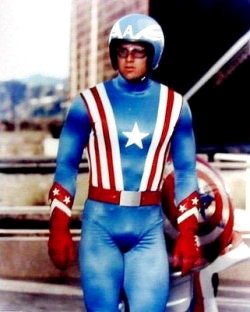
If Thor was considered a hard enough sell, imagine the headaches you'd get with making a film about Captain America. For one thing, the Captain has had two failed films made about him already. The first was an amazingly cheap 1979 two-hour TV film starring human airhorn Reb Brown in the title role, which contained a grand total of one fight scene and didn't feature the title character in his Evil Knievel-esque costume for over an hour; and the second was a more ambitious 1990 affair that only saw theatrical release in the USSR (no, I'm not making that up), and had the dubious honour of the son of J. D. Salinger playing the protagonist. Both of these films depicted Captain America as ineffectual weaklings who acted downright cowardly at times - not a good start.

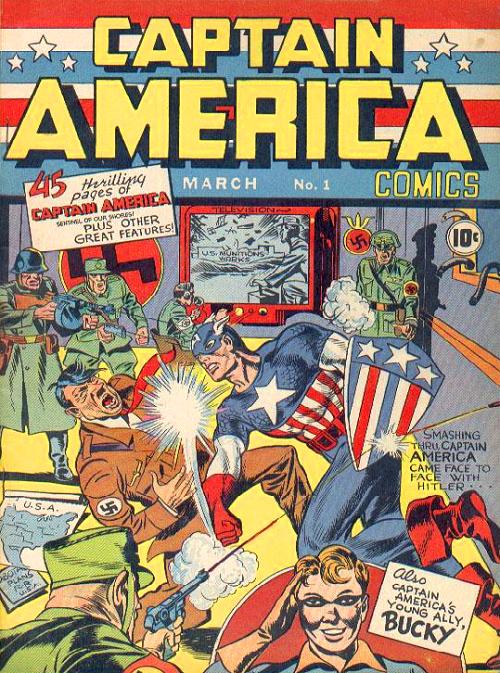
Even if you ignore the track record, look at the character himself. He was designed as a propaganda figure by Joe Simon and Jack Kirby in 1941, as you'd imagine any character whose first cover featured him punching out Hitler, with a ridiculous uniform that has never exactly looked good in live action, which is something of a tough sell internationally (if they'd released a Captain America film in 2005 in Britain, when about half the population hated America, it would have been torn apart). Personality-wise, like Superman, it's often difficult to write for Captain America because...what the hell can you do? He believes in freedom, truth, justice, and keeping people safe. He's ridiculously well-mannered. Physically, he's nigh-superhuman, and he's a brilliant tactician. Bit of a dull character on paper, and not one that lends itself to Hollywood's usual three-act films that demand character arcs - what one could you give to the Captain that would stick?

Somehow, director Joe Johnston (the man behind the excellent Rocketeer movie), writers Christopher Markus and Stephen McFeely, and actor Chris Evans found a way to make this work. How well? Stand at attention, soldiers, we're reviewing Captain America: The First Avenger after the jump at oh-right-fucking-now hours. Fall in!