Showing posts with label review. Show all posts

Friday, 30 May 2014

The Drum Beats Out of Time (An Edge of Tomorrow review)

Poster by Simon Delart.
Disclaimer: I, Jackson Alphonse Connell, being of sound mind and body, do solemnly swear to never mention the 1996 science fiction comedy film Groundhog Day while discussing the 2014 science fiction action film Edge of Tomorrow. The premise is already destined to invite more comparisons from other film critics, and I do not desire to add to those. This paragraph shall therefore be the first and only time I refer to Groundhog Day, and if I deviate from this, then may I be strapped to a chair and forced to watch Project X until my mind folds like a red-hot Mars bar.

Got all that? Good.

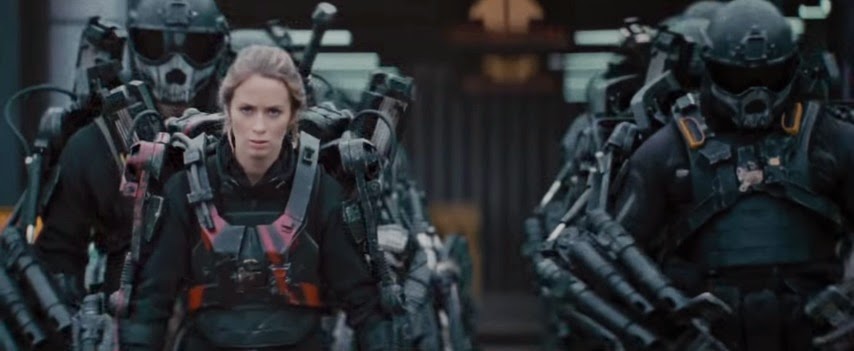
Based on the light novel All You Need is Kill by Hiroshi Sakurazaka, Tom Cruise IS Major William Cage, and despite having a name picked straight out of the Jar of Action Hero Noms de Guerre, he's a smug ad man working for the United Defense Force who's made a comfy job out of convincing brave men and women to strap on a mech-suit and die fighting a bunch of tentacled beasties called "Mimics". His cushy lifestyle runs out when General Brendan Gleeson sends him to the front line for a last stand against the alien/robot/Cthulhu(?) menace. You'd think sending a PR guy frightened of the sight of blood into battle would be a stupid idea, but it hardly matters since the operation is doomed from the start and everyone, including Cage, dies horribly.

Then he wakes up. The day's begun again. He's given grunt boots, Sergeant Bill Paxton gives a rousing speech about how combat makes everything equal and how we're the masters of our own fate, he makes himself unpopular with the international squaddies he'll be fighting with. Cage goes through the battle again, lives slightly longer, dies, then wakes up in the same place he started from. He's caught in a time loop, constantly fighting the same battle, and with the help of Rita Vrtarski (Emily Blunt), the so-called Angel of Verdun, he learns how to use this to end the war.


What Edge of Tomorrow resembles most is a 2000AD comic strip, that classic staple of British science fiction based around high concept ideas, hard-edged violence, attention to world-building and a streak of morbid humour running through it. Certainly, the decision to set most of it on a French coast and open with a battle strongly reminiscent of Saving Private Ryan adds to that impression. Then again, what other SF action flick would have a scene set in a dead caravan park? A movie that hinges around repetition would get stale quickly, and it's to Liman and the writers' credit that every new scenario feels fresh and offers some new development, even with the clunky exposition courtesy of Noah Taylor's moustachioed doctor. Quite a few scenes play out with the sense that Cage knows what's already happened, with an air of ambiguity over how many lives he's gone through to reach that point. Like a 2000AD story, it zips along at a brisk pace, with director Doug Liman using fake BBC/CNN news footage to set up the world from the start, then settling into the meat of the story.

And that story is Tom Cruise, one of the biggest stars in Hollywood, dying a whole lot. Liman mines some laughs out of the silly, often amazingly quick ways Cage bites it - sometimes he's run over, sometimes he's squashed, but more often than not it's Vrataski shooting him in the head to reset the timeline. See, Cage's alien-infected blood gives him that power, and if he loses too much of it or gets it replaced, he loses the gift, so every time he suffers a big injury (which is quite often), Vrataski elects to start over by killing him and picking up where they left off the next time around. Having gotten used to the idea of Tom Cruise as an ageless robot man not affected by the elements, watching him die over and over and over again is surprisingly cathartic and enjoyable. I don't think Sean Bean has died more times in his entire career than Cruise does in Edge of Tomorrow.


Ghoulish satisfaction aside, I like how Cage has an arc throughout the film. He starts as an oily coward, more suited to selling an image and counting the money while countless people die horribly in battle, and constantly tries to get out of actually having to do a goddamn thing. His first deployment has him shivering, pale, a film of snot running to his mouth, a rare look for Cruise and one that reminds you that, yes, beneath all the Scientology craziness there is a good actor somewhere there. Cage learns to adapt, to change, to plan, and he becomes a hero in a way that feels earned.

This isn't to overlook his co-star. On the contrary, I came out in love with Rita Vrataski, and not just because she's the only character in the movie taking on the Mimics with a giant helicopter blade as a sword. (Not completely, anyway.) The "Full Metal Bitch", as she's charmingly dubbed, has been through the time loop before, and her cold behaviour is the result of dying thousands and thousands of times fighting a pointless battle, watching comrades die the same way over and over, earning a title she doesn't feel she warrants. This never undermines her as an action hero, however; there's no frail bird waiting to be nursed back to health. Blunt gets just as many opportunities to be badass, maybe even more so than Cruise.

There's a pleasing weight to the mechanised battlesuits the protagonists wear into battle. I maintain that the best visions of the future in SF films are ones that look lived-in. Spare me your chrome skyscrapers and sleek cars that look like they've been designed by Apple, and give me dirty grimy machines held together with duct tape. I can imagine actual humans using them, repairing them by hand, struggling to turn the safety off. That's what gives CG actual presence. Less successful are the Mimics themselves, an ungainly cross between the Sentinels from The Matrix and the bugs of Starship Troopers. They move at an unsettling gait, but they lack the sense of crushing dread provided by the former or the gruesome murderiness of the latter. They just seem to punch people to death with their tentacles, because we got to keep that PG-13 rating.


Edge of Tomorrow might be the best video game movie made so far, and you can take that as a positive or a negative, but it really reminds me of cult dungeon-crawler Dark Souls, the closest gaming has gotten to recreating a trip to the village dominatrix. Like Edge, the game is built around a protagonist going up against an unfairly large opponent, being reduced to jelly, picking themselves up and figuring out how not to be reduced to jelly. Cage and Vrataski map out their plan to win step-by-step, which direction to turn and when a Mimic is going to appear, and it's satisfying to watch characters we're invested in get smarter and get closer to victory.

That's the heart of what makes Edge of Tomorrow work. It isn't too interested in the philosophical aspects of its story, but it mines the most out of its gimmick and centres it around two solid characters and has just enough smart to distinguish it amongst other popcorn films. Liman doesn't quite land the ending, but it's still a taut muscular action romp that feels like a return to form not just for Cruise, but for his director. Sometimes that's all you need.

Now if it had just retained the original title.

Thursday, 29 May 2014

Art of the Invisible (A Wolf of Wall Street review)

Poster by Daniel Devoy, sourced from designers of tumblr. 
With this money comes problems, and with these problems come solutions.
The Weeknd, "Coming Down" 
Money is just one of things I've never really understood. I get its purpose as a way of getting things, but how it actually works, the mechanisms of the stock market and the exchange rate, that's some arcane science you need to spend six months consulting Old Moore's Almanac before you properly grasp it. All I know is that when I decide I want something to drink, I hand over the little papery thing in exchange because the Bank of England has promised the guy behind the till he's actually getting five English pounds for his trouble. It's a £5 note because someone told us.

Jordan Belfort, at least the smooth charismatic one played by Leonardo DiCaprio, seems to get this, explaining to the audience the inner workings of his schemes before noticing the glazed look and moving on to the juicy details. So too does his mentor Mark Hanna (Matthew McConaughey), a deranged Wall Street broker going through life in a constant narcotic haze. It's all about faking it, you see, if you want to get ahead. "Nobody knows if a stock is going up, down or fucking sideways, least of all stockbrokers. But we have to pretend that we know." He dispenses valuable advice to his protegé all the while snorting coke and getting Martinis delivered to the table every five minutes and doing some weird chest-beating chant that only makes sense to him and that the young Belfort will later turn into a war cry, all while emphasising that a stockbroker's only goal is to move the client's money to his pocket in such a way that the customer won't even notice.


So monetary exchange becomes an act of magic. Or, more accurately, an addiction, a drug. Hanna outright states that clients end up suckered in because they're hooked on the idea of getting even richer, and Belfort describes it as his favourite for how it makes you feel invincible. After all, with enough money, you can make anything happen. Save endangered animals, keep children and runaways off the street, buy your dear old mum the house of her dreams. Belfort would have you believe that the green stuff makes you a better person.

Not that he's a testament to that ideal. The Wolf of Wall Street's greatest strength is making Jordan Belfort, the author of the memoir the film is based on, an unreliable narrator. His frequent addresses to the audience are taken from Richard III, where the amoral protagonist takes the viewer under their wing and explains their actions, making them complacent in their deeds. A lot of criticism has been thrown at the film for glamorising the various partners and brokers of Stratton Oakmont, and all the bacchanalian shit they got up to. It doesn't help that quite a few places have been throwing "Wolf of Wall Street Parties".


They were probably watching a different film. The hedonism of Stratton Oakmont isn't stylised and aspirational, it's sweaty and writhing and covered in bodily fluids. An early celebration involving a nude marching band and a seemingly infinite supply of strippers quickly descends into a strobe-lit frenzy as women are tossed to the floor, underwear discarded by a bunch of men in braces and ties with their tongues hanging out, all set to the nightmarish blues of Howlin' Wolf. Martin Scorsese has dealt with this "portrayal = endorsement" mindset before in the likes of Goodfellas, and he isn't letting up here.

This is where Belfort as an unreliable narrator comes in. It's easy to accuse the film of sexism, what with every female character who's of legal age being hit on at the very least, and every other woman being part of an endless wallpaper of tits and Brazilian waxes. With the exception of the confident and calculating Naomi (a superb Margot Robbie, playing her as the only woman who can render Belfort a whinging puppy), they're not a major part of the story. But that story is Belfort's, and it's a story he edits on the fly to make himself look good. Scorsese and his Boardwalk Empire partner Terence Winter open with the title character driving a red Ferrari, which then changes to white mid-shot at his insistence. He glosses over the bloody suicide of one of his employees. He thinks his car is pristine after driving it home while whacked out of his skull, only to realise in the morning it looks like he drove it through a hurricane. You can't trust him.


And even if you did, he's not someone you really want to be like. He takes expired Quaaludes by the dozen with his deranged right-hand man Donnie (Jonah Hill) just to get a hit. The result is both men turning into drooling imbeciles who nearly kill themselves and destroy their business in an utterly hilarious scene that approaches Mr Bean levels of slapstick brilliance. Hanna makes the point that to work on Wall Street, you need to snort coke and wank in the office toilet at least twice a day. To be a stockbroker is to become a horny jagoff who literally can't get through the day without furious masturbation and doing enough yayo to fell a bison. Dare to dream, kids!

It's weird how, in 2013, DiCaprio appeared in two films about the dark side of the American Dream: this and Baz Luhrmann's adaptation of The Great Gatsby. While Luhrmann was too swept up in the glamour of the Roaring Twenties to really get to the heart of the source material, Scorsese is under no illusions, and it's fantastic to see an elder statesman of cinema make a film as fearless and powerful as this. Starting from humble beginnings, shedding your old skin and becoming a demon in the process is what the American Dream is now. And it's not like any of us haven't thought of it. We all have lists of What I'll Do When I'm Rich. Men like Belfort are grown in that environment. It's fitting the film ends with him delivering a Get Rich Quick seminar (introduced by the real Jordan Belfort no less) trying to get a bunch of stammering yokels to "sell me this pen". The exact phrase he used to get the original founders of Stratton Oakmont together.

Another wave of wolves pretending to be lions, then. Another congregation in a dark church seeking to become better people. Another hundred Jordan Belforts in the waiting.

I come from a world where even the signposts are fictional. Follow the white rabbit. Second star to the right and straight on 'til morning. And a more recent one, from forty years ago, the fictional direction given by a mysterious man to an eager journalist: follow the money. Economics is an artform. It's the art of the invisible. Money is fictional.
Warren Ellis 

Thursday, 19 December 2013

A Life in Six Stars (A Cloud Atlas review)

Poster by Tumblr user WatsonPrime.
"The eternal hourglass of existence is turned upside down again and again, and you with it, you speck of dust!"
Friedrich Nietszche, The Gay Science
The universe begins to look more like a great thought than a great machine.
James Hopwood Jeans 

I. Dogs of Diogenes


Most of the people who know me, or who just take a glance at my Facebook timeline, would tell you I'm cynical. I question what's presented, tear it open, and try to divine the truth from its entrails. In truth, it's a side of me I'm actively trying to fight, or at least keep on a leash. To be a cynic nowadays means to be jaded, to have little to no faith in humanity. This isn't, of course, how it used to be. The philosophy of Cynicism, the kind espoused by Antisthenes and Diogenes and the like, espoused virtue above all else, prizing a free happy life as the greatest thing one could possibly have.

I wouldn't say being a Cynic, rather than a small-c cynic, appeals much more to me. Being a Cynic sounds like going straight-edge, or like following a warrior's code; nothing is more important than virtue. Not money, not power, not hygiene, not reputation, not society. The name itself comes from the Ancient Greek "kynikos", meaning "dog-like", and initially lent itself to insults; Cynics were frequently called dogs for rejecting societal norms and living in the streets, though Diogenes took it as a compliment: other dogs bite their enemies, I bite my friends to save them. To be a dog meant being free and loyal to your cause.


At some point down the line, Cynicism lost the privilege of a capital letter, moving from evangelical crusader for happiness to bitter loner on the outer fringes of society. And while small-c cynics can certainly have an eye for improving life and human interaction - that's probably what fuels our most well-known grumpy bastards - all too often, that noble goal gets lost in favour of being perpetually disillusioned and getting a sense of grim satisfaction when things go tits-up. It's trendy to be cynical. It's even bled through into our entertainment, with the heroes of Western fiction - films, video games, TV, comics - becoming increasingly harder and sociopathic, to better appeal to our power fantasies. Even when they "win", it's a Pyrrhic victory. Man of Steel ends with Superman killing the last survivors of Krypton. John McClane is no longer an Everyman cop who can get hurt, he's a Category 5 hurricane made of bullets.

Too many of us are cynics.

II. From Heaven to the Gutter


Talking about Cloud Atlas really is like dancing about architecture. The original novel by David Mitchell has a narrative structure like a Chinese puzzle box, with six different stories in six different styles nestled within each other, interrupting one another before reaching the middle, with each one being wrapped up in succession. These stories are, in order:
  1. American lawyer Adam Ewing (Jim Sturgess) travelling across the Pacific Ocean in 1849, saving a runaway Polynesian slave (David Gyasi) from death even as he slowly succumbs to illness from a parasite. His adventures are chronicled in a journal, read by...
  2. English musician Robert Frobisher (Ben Whishaw), disgraced son of a wealthy family, as he flees to Edinburgh (Belgium in the book), to become the apprentice of renowned composer Vyvyan Ayrs (Jim Broadbent) and prove himself as a musician. He writes about his experiences to his lover Sixsmith (James D'Arcy), who retains the letters well in to old age, which eventually fall into the hands of...
  3. Investigative journalist Luisa Rey (Halle Berry), who is tipped off by an aged Sixsmith about foul play involving a new nuclear reactor being developed in San Francisco during the 1970s. Key figures in the reactor's development turn up dead, and time's running out on Rey to figure out the mystery. Her story becomes the basis of a manuscript, Half-Lives: The Mystery of Luisa Rey, read by...
  4. Vanity-press publisher Timothy Cavendish (Broadbent) in 2012, experiencing quite a windfall when his Irish gangster client throws a well-known critic out a window. Eventually, his client's family come knocking for their share, and in an attempt to flee London ends up being tricked by his elder brother (Hugh Grant) into incarceration at a brutal nursing home. He soon turns this into a screenplay called The Ghastly Ordeal of Timothy Cavendish, a film watched by...
  5. Somni~451 (Doona Bae), a clone waitress living in a futuristic Korea, forced into servitude by the caste system. After her friend is killed for disobeying orders, she's taken under the wing of a revolutionary movement and falls in love with one of their leaders, Hae-Joo Chang (Sturgess). The movement fails, and before her execution, she makes one last recorded statement to the world, which centuries later becomes the holy text of a religion followed by...
  6. Zachry (Tom Hanks), a shepherd who lives on the island formally known as Hawaii, 106 winters after "The Fall". After his tribe is beset by the cannibalistic Kona tribe, he allies with Meronym (Berry), the ambassador of the last remnants of futuristic society, to preserve what's left of "The Smarts"; the technology their ancestors left behind.
The structure looks something like this.
What's particularly clever is how they all link. Each story is a text being read by the protagonist in the next narrative; the transcription of a revolutionary's last words in Story E becomes the basis for a religion in Story F, for example. And then there's the very real possibility that these stories may not be completely true. Frobisher notes how Ewing's journal seems too neatly structured to be the real thing, yet his own composition, the Cloud Atlas Sextet, is structured exactly like the novel, a sextet with overlapping stories, and a character in his story reappears in Half-Lives, which is a manuscript for a novel. It's metafictional, stories within tales buried in narratives.


It's this unique structure that led many to declare the book unfilmable, but people should really know by now that particular label will only dare filmmakers to try even harder. Tom Tykwer managed to get a decent adaptation out of Patrick Susskind's Perfume: Story of a Murderer, another daunting task for bibliophilic screenwriters. But he couldn't do this alone; he needed the help of Andy and Lana Wachowski, massive fans of the book, and who have never shied from the task of trying to carry big ideas to a mainstream audience. The Matrix was a distillation of Baudrillard and Plato and Gnosticism, after all, wrapped up in a kung-fu superhero action movie. Hell, Tykwer's own Run Lola Run dabbled in talks of free will versus determinism and chaos theory, giving a philosophical bent to a hard and fast action film scored to pulsing techno.

In short, these three specialised in the mixture of high and low culture. In that sense, they were the perfect people to adapt Cloud Atlas.

III. "The Weak Are Meat..."


Mitchell described the story as being about "predacity, the way individuals prey on individuals"; cannibalism and greed are recurring features in all the stories. Dr Goose (Hanks) remarks to Ewing that the Pacific beach they're standing on was once "a cannibal's banquetting hall"; Ayrs intends to screw Frobisher out of the royalties earned from The Cloud Atlas Sextet; the greed of an energy company causes Rey to start sniffing around; Cavendish flees to Aurora House, unable to pay his client's murderous family, and jokingly wails about how "Soylent Green is made of people!" to the confused residents; fabricants who've served their purpose are a cheap source of protein in Neo-Seoul; Zachry's tribe are routinely at danger of becoming the Kona tribe's dinner. As Goose puts it, "the weak are meat, and the strong do eat."

The Wachowskis are fond of this as a trope. All of their works are about free-spirited individuals fighting against a faceless System, the tide forever bashing against the rocks until it's shaped for the better. Speed Racer sees the title character and his family continuing to race in defiance of a decades-long conspiracy to fix competitions for corporate interests. The Matrix has the faceless Caucasian government agents as servants for a collective of machines leeching humanity of power, while the free people of Zion are multi-racial and full of life. Their script for V for Vendetta has the System in its most primal form - a tyrannical government who rule over every aspect of life, using the outsiders (the blacks, the gays, the foreigners) as lab rats.


Such is the case with Cloud Atlas. Every story has the protagonist fighting against their fate, in bitter refusal that this is how things are meant to be. The most obvious is Somni waking up from a life of drugged ignorance, living as a slave with the hopes of one day reaching the end of her contract, and bringing down the corporate government. It manifests in other ways, however. Frobisher wants to prove to his "Pater" that he can make it on his own, and his attempts to retain the rights to his Sextet lead to him going on the run from the law yet again. Aurora House is a prison, but Cavendish and his motley crew attempt to break out regardless. Ewing's actions lead to Autua becoming a freeman, and he and his wife later announce their intentions to join the abolitionists, a decision that riles his father-in-law: "there is a natural order to this world, and those who try to upend it do not fare well".


This natural order, then, is where those with power prey on those who are weak. Hugo Weaving, in all of his roles, represents this idea in various aspects: an assassin hired by a greedy power company, a sadistic nurse, a bureaucrat, a Nazi (albeit a sympathetic one, characterised more by his unrequited love, though still a representative of assholes with power), a demonic trickster. All of his appearances, from Haskell Moore to the fiendish Ol' Georgie, mark The Way Things Are; even his Nazi commander is resigned to the fact his love for the Jewish Jocasta can never be, because that is the order of things.

IV. Psychography


At its core, Cloud Atlas is the story of one individual as they fight against the establishment to varying degrees of success. This one individual is male and female, old and young, of various classes and races and nationalities and sexualities. This individual is denoted by the presence of a birthmark on their person, in the shape of a comet; it appears on Ewing's chest, Frobisher's lower back, Rey's shoulder, Cavendish's leg, Somni's neck, Zachry's head. There's something very Buddhist about this; the idea of a single soul returning to the mortal coil over and over again evokes samsara, a repeating cycle of reincarnation (across six realms, fittingly enough; six is somewhat important to the narrative).

With that, Mitchell, Tykwer and the Wachowskis manage to have their cake and eat it, crafting a story that's human and intimate, while also being epic on an unprecedented scale - not just in terms of setting, hopping back and forth from post-apocalyptic Hawaii to Edinburgh at the turn of war, but the characters. Cloud Atlas has a large principal cast of thirteen actors (American, British, South Korean, Chinese and Australian) playing multiple roles across all of its six stories, spanning gender and, controversially, race. Tom Hanks is a Scottish hotel manager, an Irish gangster and an American scientist; Halle Berry is a black journalist, a white Jewish socialite, an Indian partygoer, a male Korean doctor; Doona Bae is an American and a Mexican; Hugo Weaving is a woman and a demon; Hugh Grant is a decaying English millionaire and a proud cannibal chieftain.


On a surface level, this racebending is uncomfortable. The film industry does have a reputation for casting white actors in roles meant to be played by non-whites (just look at The Last Airbender, with white kids playing unmistakably Inuit and Tibetan parts, or Johnny Depp and his barely-there Cherokee ancestry as Tonto in The Lone Ranger), and while Cloud Atlas is a German production, it looks guilty of that particular charge. Jim Sturgess as Hae-Joo Chang comes off the worst, though not for lack of effort on the actor's part. He's trying, but stifled by Korean make-up that's just flat-out unconvincing. To be fair, Bae's Caucasian prosthetics and very noticeable contacts are similarly dodgy. In any other film, I would call bullshit, but Cloud Atlas feels genuinely progressive in some ways. Halle Berry can appear in a period movie as someone other than a slave, and Ben Whishaw can play a neglected wife. Given that the film is about eternal recurrence, the idea that all of this has happened before and shall happen again, it makes sense. It's post-racial casting, and is decades - if not centuries - ahead of its time. The day will come when we can legitimately cast actors in roles regardless of race, but sadly that day is not today.


Speaking in terms of acting, this can get distracting; while Hanks is clearly having fun playing a Cockney-Irish brute, you can't escape the fact he's playing a cartoon, and the film will probably earn several rewatches just through games of "Spot-The-Actor". This may be intentional. It's quite jarring seeing Hanks as a kindly scientist and heroic shepherd one minute, then a giggling obsequious doctor and greedy hotel manager the next, and Jim Broadbent going from fun-cantankerous (as Cavendish) to hateful-cantankerous (as Ayrs) (could we call this switch "putting on Ayrs"?), as though the film is blurring the lines between heroism and villainy. Other times, it creates parallels; Sturgess and Bae, when on-screen, play couples, one doomed (Somni and Chang), one saved (Adam and Tilda Ewing). It's gauging your attention, forcing you to look for links. It's the difference between viewing a story as a single thread, and viewing all the stories as forming a tapestry.


The dodgier elements are, thankfully, minor, and rarely the focus of the stories. The central characters are superbly cast: Hanks's Zachry is wonderful even while speaking in a futuristic Creole, a man haunted by the devil on his shoulder but prepared to swallow his fear regardless. As Luisa Rey, Berry is the best she's ever been, tough and warm and sympathetic. Broadbent gets to showcase his skills as a dramatic actor as the scaborous Ayrs, and his comedic side as Cavendish; it probably helps that Cavendish is delightfully pompous and bumbling, rather than the bigoted jerk he is in the book. The stand-out by far, though, has to be Ben Whishaw. He plays Frobisher as arrogant and bullheaded, but thoughtful and bright and full of love: for music, and for his beloved Sixsmith. Whishaw's been one to watch for a while - his lithe build, androgynous beauty and knife-like tongue have seen him play Shakespeare's Ariel, angelic killer Jean-Baptiste Grenouille, and MI6's snide gadgeteer Q, but Cloud Atlas sees him firing on all cylinders, burning with youthful pride and ambition, and is the perfect fit for the most romantic of the six stories.

V. In Concerto


The novel's Matryoshka doll-like structure would have never worked on film, so Tykwer and the Wachowskis went with a different way of presenting the stories. Mitchell referred to it as a "mosaic"; Wikipedia calls it "hyperlink cinema". Examples of the latter description include Paul Thomas Anderson's Magnolia, Fernando Meirelles's City of God, or (more popularly) Quentin Tarantino's Pulp Fiction. It's a type of cinematic storytelling where whole plotlines interlock with each other, often in a nonlinear fashion, where connections between these often disparate stories are gradually revealed.

Cloud Atlas the film operates on the same principle. The audience is given a brief introduction to the status quos of each story, in order, and then cuts between each of them. The main narrative flow is rapidly diverted time and time again, with transitions often handled on-screen; a car in 1975 can turn the corner and the scene would cut to a hovercar in 2144, for instance. Eventually, you begin to see links between them; Somni and Chang consummating their relationship is juxtaposed with Frobisher's dream where he and Sixsmith destroy a china shop in slow-motion. How much is intentional, and how much is us seeing patterns that aren't there, like looking for familiar shapes amidst the clouds? It's the cinematic equivalent of spinning multiple plates; or, maybe more accurately, like a sextet. Each story is a soloist, or a musical phrase, playing in concert with the other stories, adding up to one big symphony.


This is nothing new, fundamentally. Cinematic language has included the Soviet montage technique of intercutting different scenes with each other for quite some time now, and Cloud Atlas isn't even the first to apply Soviet montage to whole storylines, but nothing of this ambition has been seen for a while now. Certainly, very few works transcend time, location, genre, and social categories like race and gender. And there's no sense of Tykwer or the Wachowskis half-arsing it. They believe completely in what they're doing. That's probably what makes it so endearing.

VI. The Great Thought


I mentioned, way back at the start, that cynicism is increasingly prevalent in our society and culture. This isn't to completely disparage it as an outlook. There are times when we need a trickster looking outward at the world and pointing out what's wrong with it, someone with no illusions. The problem is there are so goddamn many of these people in the world. It can give way to a general sense of misanthropy quite easily. And where does that leave you? With the likes of Bret Easton Ellis or Dave Sim, who find it easy to turn their bile onto something, and that's not good company to keep.

I went down that road once. I never want to go down there again. Cynicism and a jaded perspective are cool and all, it's fun to act superior to something (and also why writing a negative review is easier and often more enjoyable than a glowing one), but man, that can be seriously draining. It's like living on absinthe. I've made no secret about the fact that All-Star Superman by Grant Morrison, Frank Quitely and Jamie Grant shaped my belief system, and myself, for the better. In a world that's mostly cruel and chaotic, why would you want more fiction that emphasises that above all else? Not to shun everything dark and serious and weighty altogether, but add a bit more stuff about how good it is to be, well, good.


Cloud Atlas is not a complex thematic work, whatever form the structure takes. The message is very simple: "Doing good is good, doing bad is bad". Some will think it's trite and simplistic, an overtly grandiose, pretentious way of delivering a simple moral lesson. What gives it more weight is that, by mapping out all of human existence over such a broad canvas, Cloud Atlas shows how important altruism and kindness ultimately are. The world is one where power is abused, where those who are weak are routinely preyed upon and devoured. This is true of the natural world, of the concept of "survival of the fittest". So, in a life full of cruelty, the most important thing is to try and be noble.

I can't speak for Tykwer's filmography, but the Wachowskis are very positive filmmakers. The underrated Speed Racer is a big ode to the joys of family, and is shot as a pure kaleidoscope of Technicolor energy intended to get the viewer giddy. The Matrix films are about rejecting a comforting lie in favour of truth, however painful that might be. Even their 1996 effort Bound is about embracing your own identity, and had close involvement from sex-positive feminist Susie Bright, who signed on upon finding the script was full of women enjoying sex without apologising for it. So Cloud Atlas feels right at home with their brand of silly high-concept idealistic filmmaking.

There are moments, yes, when it doesn't completely work, where it falls into camp and is too overstuffed. But an honourable failure is better than a successful mediocrity, and you'll rarely see films as brave and as beautiful as Cloud Atlas.
Hello, babies. Welcome to Earth. It's hot in the summer and cold in the winter. It's round and wet and crowded. At the outside, babies, you've got about a hundred years here. There's only one rule that I know of, babies - "God damn it, you've got to be kind."
Kurt Vonnegut, God Bless You, Mr. Rosewater

Thursday, 12 September 2013

Drugs, Alcohol or Lies (A 24 Hour Party People review)


Man seeks to escape himself in myth, and does so by any means at his disposal. Drugs, alcohol, or lies. Unable to withdraw into himself, he disguises himself. Lies and inaccuracy give him a few moments of comfort. 
Jean Cocteau, "On Invisibility", Diary of an Unknown 
You know your trouble, Tony? You don't know what you are. I fucking know what you are, but you don't know who you are.
Well, my curiosity's got the better of me, Rob. Tell me, what am I?
You're a cunt.
Well, you see, I knew that, you see. That was something I did know. 
Anthony Howard Wilson can be viewed as the patron saint of Manchester, or as the biggest prick to ever crawl out of Salford. Often both. A Cambridge-educated journalist working for Granada Television, he had a reputation for being very intelligent and charismatic, but was also pompous and infuriating. Part of this was intentional - Wilson took delight in "wind(ing) up all the people in Manchester who think I'm a flash cunt", and set out to become the flashiest and the cuntiest of them all.

Wilson was growing bored with the music scene of the 70s when he attended a Sex Pistols gig at the Lesser Free Trade Hall in June 1976, organised by future Buzzcocks frontman Howard Devoto. Forty-two people watched Johnny Rotten stamp and sneer on stage amidst a squall of cheap guitar: Bernard Sumner and Peter Hook, then going by the name Stiff Kittens; Martin Hannett, the future architect of the Manchester sound; Jon the Postman, legendary for jumping on stage and treating all and sundry to his bellowed rendition of "Louie Louie"; Steven Morrissey, the poet laureate for angsty teens the world over. For them, the gig was revolutionary. Here was a new type of music, one anyone could do. If it was good enough for the red-haired tit on stage, it was good enough for them.

This lighting of the blue touch paper is captured in 24 Hour Party People - sort of. Tony Wilson, here played by Steve Coogan, points out all the important players (and Mick Hucknall) in the story, talking about their futures, like how Sumner and Hook go on to become Warsaw, later Joy Division, and how Hannett will try to kill him. He describes the gig to his producer as "history", comparing the small turnout at the Free Trade Hall to that of the guest list at Caesar's assassination. Wilson is obsessed with the idea of creating a new mythology. 24 Hour Party People chronicles how successful he was at that.

Monday, 2 September 2013

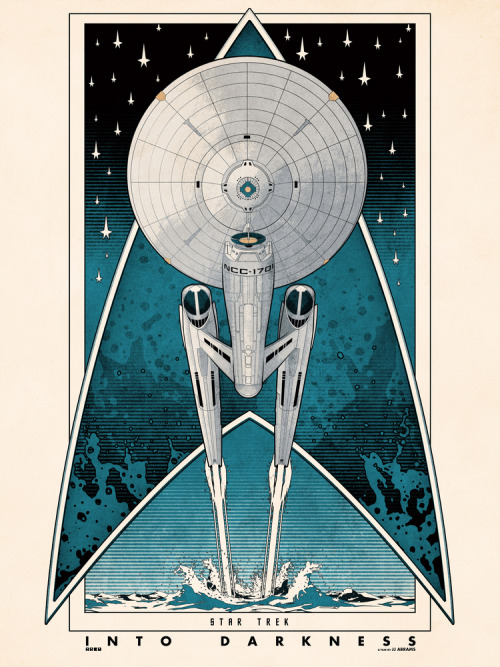
...Where Somebody Else Has Gone Before (A Star Trek Into Darkness review)

Poster by Matt Ferguson.
I don't go into films looking for problems. Really, I don't. When you go into a cinema, you're making a pact with whatever's on the silver screen - "I will suspend my disbelief, I will give you the time of day, but only if you give me something truly worthwhile". It's only fair. It's like deliberately looking for the moment when the magician slips something up his sleeve - where's the fun in that? It's better to enjoy the show.

So I went into Star Trek Into Darkness prepared to meet it halfway. I was beyond annoyed by the marketing constantly teasing the identity of Benedict Cumberbatch's villain, even though everyone and their mother and their mother's friend Jean knew who it was. But then I remembered how much I liked the previous film from 2009, which managed to soar despite a shoddy script, purely through the strength of its cast and JJ Abrams being a pretty damn fine action director. I wasn't expecting a masterpiece, I just wanted a fun little popcorn movie.

I got that movie only on the most superficial level. Star Trek Into Darkness is a film that just flat out doesn't work anywhere else.

(WARNING: This review will contain spoilers, so if you haven't seen the film, I'm sorry, but turn back now. There's no way of discussing all the bullshit that happens without doing so; it's vacuum-packed bullshit. They're clever like that.)

Sunday, 23 June 2013

Return to the Classics (A Behind the Candelabra Review)


He took out a pile of shirts and began throwing them, one by one, before us, shirts of sheer linen and thick silk and fine flannel, which lost their folds as they fell and covered the table in many-colored disarray. While we admired he brought more and the soft rich heap mounted higher — shirts with stripes and scrolls and plaids in coral and apple-green and lavender and faint orange, and monograms of Indian blue. Suddenly, with a strained sound, Daisy bent her head into the shirts and began to cry stormily.  

“They’re such beautiful shirts,” she sobbed, her voice muffled in the thick folds. “It makes me sad because I've never seen such — such beautiful shirts before.” - F. Scott Fitzgerald, The Great Gatsby

There was a time when Władziu Valentino Liberace was a king. The child of Italian and Polish immigrants in Wisconsin, he rose to success throughout the 40s and 50s tickling the ivories in a variety of increasingly baroque costumes: tuxedos and fur capes encrusted in rhinestones. His reign has long since passed. Now, when his name is evoked, it's to mark someone as flamboyantly gay; Wallace Wells in Scott Pilgrim vs. the World refers to him as the writer of the "Gay Handbook". It's obvious now looking back at him with hindsight. This guy, with his glitter-encrusted bouffant hairpiece, soft lilting voice and face dolled up to the nines? How did people not know he was gay?

Those people had the obvious answer: gays were decadent demons bent on corrupting your children, humping you in back alleys like a dog taking a bitch, and dragging America into a cesspool. They weren't entertainers, they weren't the softly-spoken man doing renditions of Chopin and Berlin, and they weren't richer than Croesus. Liberace was successful, popular; even when his star faded from the mainstream in the 60s, he remained a darling on the Vegas circuit, selling out night after night, working round the calendar, and living in a miniature Nevada palace. In the words of Roy Cohn from Angels in America, homosexuals were "men who know nobody, and who nobody knows". Liberace was successful, ergo he was a bachelor who just hadn't met the right woman yet.

Bob Black (Scott Bakula) says as much in the opening minutes of Steven Soderbergh's Behind the Candelabra. When Liberace (Michael Douglas) wheels out his protégé (Cheyenne Jackson) for a quatre mains duet, Black jokes about them being "a pair of queens", earning him the outrage of an elderly woman sitting in front. To the surprise of his partner, Scott Thorson (Matt Damon), only the two of them, expatriates from the gay underworld, can tell he's hiding in plain sight.

Friday, 14 June 2013

...In a Single Bound (A Man of Steel Review)

Poster by Martin Ansin.
Behold, I teach you the superman! - Friedrich Nietzsche

The generic template for a superhero is a man in spandex and tights flying about doing good, cape billowing in the wind, and it all started 75 years ago. Superman is more than just a superhero. To paraphrase Tom Baker, he's The Superhero. The definite article, the idea given form. As in fiction, Superman has two fathers: writer Jerry Siegel and artist Joe Shuster, who had been plying their craft in the funnypages for years before striking gold. The Superman that appeared in Action Comics #1 was a socialistic demigod, not yet capable of flight, but able to leap tall buildings "in a single bound!" and more than willing to let might make right, fighting against injustice from the street on up.

Over time, Superman evolved into the airborne friend of humanity we all know and love. Well, the one we should all know and love, if it weren't for that emotionally crippled upstart in the bat costume. In film, Superman has had several earthly incarnations. Christopher Reeve pretty much wrote the book on Superman with his mannered, detailed, fantastic performance in Richard Donner's 1978 film, a high every other adaptation has tried to recapture. Superman II suffered from executive interference, leading to two quite different cuts circulating; Superman III had Richard Lester up the slapstick to diminishing returns; Superman IV: The Quest for Peace was...just...sad to behold; and Superman Returns tried in vain to recapture Donner's glory days and instead gave us Superman as Deadbeatdad Man.

Now Zack Snyder, of 300 and Watchmen fame, steps up to the plate for a newer take on the Last Son of Krypton. Warner Bros. have obviously been eyeing up all the bank the Dark Knight films have made, and are keen to recapture the success with Christopher Nolan overseeing production, and David S. Goyer providing a script. Keep in mind, when a studio attempts to catch lightning in a bottle twice, all that's left are burns, so how does Man of Steel manage?

Saturday, 18 May 2013

All the Sad Young Men (A Great Gatsby review)

Poster by Sharm Murugiah.
I felt (adapting Gatsby) was a very chancy thing to attempt. A lot of what was in the novel was by suggestion. So much of it was in prose and so much of it was utterly untranslatable, and even if you could translate it, I thought it would be a thankless task and you'd just be some Hollywood hack who fucked up a classic. I felt that I had a lot to lose and very little to gain. That whole book is a mirage. - Robert Towne
Often considered a candidate for the title of "The Great American Novel", and more likely considered by every high school student as "that book in the 20s that's full of assholes", The Great Gatsby went unappreciated upon release, with F. Scott Fitzgerald going to his grave believing his work was a failure. The book got a second wind in 1942, where it proved to be incredibly popular with soldiers, and soon with the rest of the world, including Hollywood.

There have been, to date, four previous film adaptations of Fitzgerald's novel - a 1926 silent version by Herbert Brenon of which only a trailer survives; Elliott Nugent's efforts in 1949 which is difficult to get a hold of; a made-for-TV movie in 2000; and the most well-known, the 1974 adaptation with Robert Redford and Mia Farrow, boasting a script by Francis Ford Coppola. By all accounts, none of these really came close to the mark. Robert Towne turned down a handsome offer of $175,000 to adapt Gatsby, plumping instead to write his original screenplay Chinatown for $25,000, because he considered Fitzgerald's kiss with a fist to the Jazz Age unfilmable.

So along came Baz Luhrmann to take his stab at it with his loyal co-writer Craig Pearce. You've got to admire their ambition, at least.

Saturday, 16 February 2013

Spaghetti Southern (A Django Unchained review)

People have asked me many times, 'Why is Django so successful?' I tell them this: because Django was for the workers. He represents all those guys who've ever said, 'Let me tell ya something. I'm gonna go tomorrow and see my boss and say, "Things are gonna be different from now on..."' - Franco Nero
Released in 1966, Sergio Corbucci's Django is the blood-soaked tale of a lone drifter wandering across the Wild West, dragging a coffin behind him, seeking vengeance in the name of his wife. Often considered one of the most violent films ever made (the title character gets his hands crushed, a man is forced to eat his own severed ear), it found a global cult audience everywhere except the UK, where it was banned for twenty-odd years. Django as a "series" (for want of a better term) has been odd; there's only been one official sequel with lead actor Franco Nero (1987's Django Strikes Again), but characters named Django have appeared in thirty-one films, mostly played by different actors.

So Django Unchained, Quentin Tarantino's second blaxploitation flick after Jackie Brown in 1997 AND his first stab at making a Spaghetti Western, fits into this weird little canon. And, true to Tarantino form, it might be one of his best yet.

(NOTE: This entry discusses racial slurs in a fair amount of detail, so this may be NSFW.)

Monday, 17 December 2012

Phonomancy Track 1: Scott Walker

In recent months, I've kinda sorta gotten addicted to Phonogram, Kieron Gillen and Jamie McKelvie's fantastic comic about music and the power it has on our lives. Even if you don't normally read comics, it's very well-written and features lovely artwork; I'd start with The Singles Club, it's a good introduction. In the spirit of this, I'm doing an ongoing series of posts about some of my favourite musicians and acts.

Today, we'll start with one of the most influential, and one of the most enigmatic men in rock music.

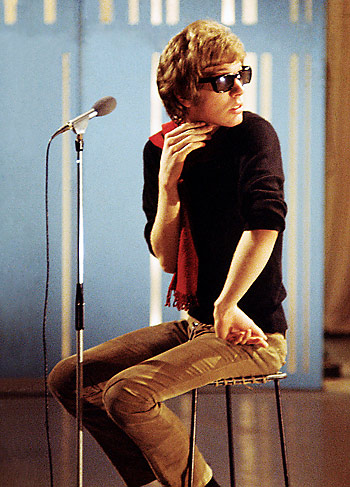
It's difficult to talk about Scott Walker without speaking in hushed tones, without treating him as some sort of minor musical god, and shading his history in such a way to make him seem like legend. To be fair, the man has led a very interesting life. A Californian high school drop-out with a taste for European art and culture, this is a man who at one point was the most adored young singer in the United Kingdom, and now unwinds by doing interior decorating. His work nowadays is like the soundtrack to a Kafka story, nightmarish existentialist soundscapes laced with surreal humour, in between producing Pulp records and collaborating with Bat for Lashes. His music has influenced so many, particularly his records from the 1960's, he's like Year Zero for indie music: David Bowie, the Smiths, Neil Hannon, Jarvis Cocker, Goldfrapp, Damon Albarn, Radiohead (to the point "Creep" was informally dubbed "(their) Scott Walker song")

If you're into alternative rock, understand that Walker is probably your favourite musician's favourite musician.


Born Noel Scott Engel in 1943 in Hamilton, Ohio, Walker was nomadic from an early age. His father worked as a geologist, meaning the family moved across America, settling in California. Walker was kicked out of high school and says he spent his time hitchhiking around the States; this was the beatnik era, where hundreds of wide-eyed disciples of Kerouac set about hitting the open road on would-be spiritual journeys. These people are pretty much ten-a-penny nowadays with the rise of the gap year, but in the late 1950s, this was bold exciting stuff. And it was while playing bass guitar on the Sunset Strip that he and his friend John Maus got the call from Gary Leeds to come to "swinging London", a trip that would change everything.

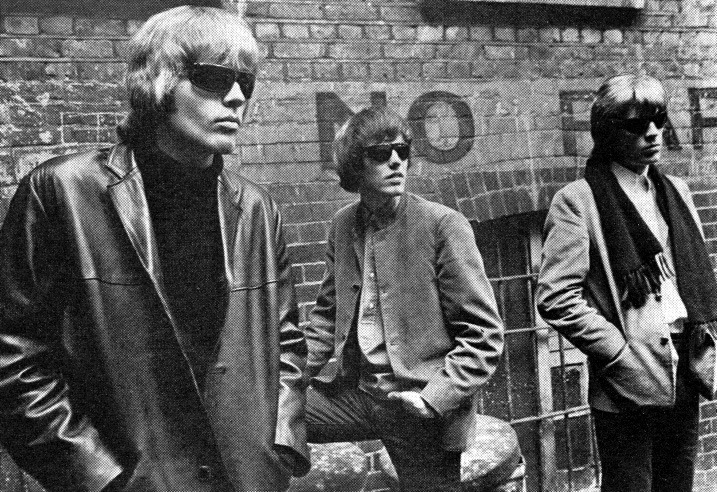
Scott and John had been performing across California for a while now as the Walker Brothers; John was annoyed at people pronouncing his surname as "Moose" and so adopted a stage name. Scott also took the surname "Walker" - both tall, blond and handsome, they could be mistaken for brothers, and there was a nice ring to the name "The Fabulous Walker Brothers". Given that they never played their own instruments, instead using experienced session players - Gary wouldn't even play drums live - the sheen of plastic to the name is fitting. While they were regulars on the Sunset Strip, particularly Whisky-A-Go-Go, they never had any breakout success, but Gary Leeds, the soon-to-be third Walker Brother, had recently come back from a tour in the UK with singer P. J. Proby, and encouraged Scott and John to take a visit to the swinging scene. They ended up signed to Phillips Records by John Franz - and, conveniently, avoiding the draft for Vietnam.

In 1965, London was rapidly becoming the hippest place to be, daddy-o, especially when it came to music. The British Invasion had begun, with The Beatles, the Rolling Stones, The Kinks and The Who all making waves in the US, psychedelic rock was laying down the roots for the oncoming wave of prog (acts like Pink Floyd and Cream), and Radio Caroline was merrily broadcasting all kinds of rock music the BBC wouldn't play from its two stubborn ships in Felixstowe and Harwich.


It was the time to be young and gay and merry, but the Walker Brothers offered an immediate contrast. For one, rather than British musicians conquering the Colonies, they were three young handsome American gentlemen coming over to grace the Sceptred Isle, elegantly dressed and effortlessly cool, compared to the Stones' rugged sneering "don't give a hoot" attitude and the Beatles' cheeky fresh-faced teenybopper reputation. They sang of doomed romance and loneliness from songsmiths like Bacharach, Gaye and Newman, with a rich full Wall of Sound-esque comprised of big sweeping orchestras amongst tight rhythm guitars; a sense of melancholy hung about their work, one that resonated with a Britain that still had scars from the war.

More than anything else, though, they had Scott's voice. Back on the Strip, he'd just been the bass player while John was lead vocalist, and an early Walker Brothers cut, "Pretty Girls Everywhere", featured him as such, but failed to go anywhere. For the song "Love Her", a deeper voice was required, and it was this rather than "Pretty Girls" that got radio attention. Since then, Scott had become the de facto face of the group. And oh, what a voice, dear reader. Just so you know I'm not waxing romantic, listen to one of their best songs, a cover of Frankie Valli's "The Sun Ain't Gonna Shine (Anymore):


Those of you who watch The Walking Dead may recognise this from one of the first trailers. It's a cracking song in its own right, and Scott's voice is one of the main selling points, a smooth deep baritone that pleads with his sweetheart to shed loneliness and let him in, or else the celestial bodies themselves will cease to be. It's a sentiment so overwhelmingly romantic it sounds downright hysterical when put in text divorced from the music, but then everything about this is big and grand and clawing its way towards Heaven.

At one point, the Walker Brothers were the biggest thing in Britain. Their official fan club had more members than The Beatles' did, although this is not to say they had more fans altogether than the Fab Four. They were massive, is me point, and their concerts would last maybe one or two minutes before screaming fans would rush the stage. This didn't sit easy with the shy introverted Scott, who never got used to the wild attention and was always more interested in music. The resulting tensions, creative differences (for there are always creative differences, it would seem) and a reported suicide attempt by Scott led to the group splitting up, with Scott pursuing a solo career.


The first hint of Scott's ambitions as a musician lay in the B-side to the single "Deadlier than the Male", a baroque little number called "Archangel". Six months before "Whiter Shade of Pale", the Gothic organ refrain was recorded at the Leicester Square Odeon, using the cinema's in-house pipe organ. Inspired by Bach and filled just as much with images of kitchen-sink drama as it was the supernatural, the single failed to get further than the Top 30, and so "Archangel", with its Gothic depiction of post-war London, sadly went unnoticed.

The self-described "classic bore at the party", Scott's interests were cultural and intellectual, particularly classical music and European cinema, and so he got a kick out of seeing characters from Ealing comedies inhabiting the streets of London. It was while drinking at the London Playboy Club that he was introduced, by a girl who took him back to her place, to Jacques Brel, the Flemish chanteur who Scott declared to be "the most significant singer-songwriter in the world". A painfully shy man whose live performances always resulted in him sweating more than Lee Evans in a walk-in oven, and who sang of gonorrhea, sadomasochism, Amsterdam, sons lost in war and the cowardice of men, Scott identified with Brel instantly, and it was through English covers of his work that he began to strike out as the thinking man's pop idol. Breaking free of the teen idol image is always a tricky one, but I can't imagine a more violent attempt to burst out of that cocoon than by singing songs about "authentic queers and phony virgins":


"Jackie" remains one of my favourite Scott songs. Not because it features my name or anything, that's coincidence (and it's pronounced "Jacques-y" in the song anyway). It's how brash and bold and outright rude it is, how punk it is before "punk" even became a word (Julian Cope, of post-punk band The Teardrop Explodes, is a passionate Walker fan), yet it's set to such a storming, uplifting orchestral backing. Thank Angela Morley, then Wally Stott, for the fantastic arrangements, which she would provide for Scott's four solo albums. Any singer who claims influence from Brel, they were introduced through Scott; Brel sang as though he were terrified of the hurricane he was unleashing, whereas Scott sang with style and panache, like Apollo at the Royal Albert Hall.

The albums soon became dominated with his own compositions, and he began to emerge as a singer-songwriter more and more with every release. The common assumption is that there are two iterations of Walker: the intellectual crooner, like Sinatra for the Left Bank; and the modernist composer who came along out of nowhere. The division isn't quite that simple as people believe; you had the influence of Brel on tracks like "The Girls from the Streets" and "Montague Terrace (In Blue)", but what seems to pop up more often is the vivid, dreamlike fantastical imagery that would dominate his modern work. I'm going to try and let them speak for themselves,  so listen to the posted tracks, but I'll also include some choice excerpts.


While doing Poetry last semester, I looked to Scott's lyrics an awful lot, particularly for Romantic-era poetry. I love the way he gives abstract images and concepts weight and sensation - "thoughts like shattered stone", "scent of secrets", "fist filled with illusions", and a salesman who "smells like miracles" (from "Rosemary").


Also from Scott 3, we had "It's Raining Today", and people wondering how modern Walker came about need listen no further than the first couple of seconds and its unearthly string section - not quite discordant but not really musical either, it hangs over the record and sets the tone so well.


His first few solo albums were top sellers, but that run of good fortune came to an end with Scott 4, which failed to chart and was soon deleted, with Walker slowly fading from the limelight in the process. There are many theories as to why 4 failed to chart while Scotts 1-3 did; the most common is it being released under the name "Noel Scott Engel", while Scott attributes it to most of the songs being written in 3/4. Personally, I think people were just getting tired of this particular brand of chamber pop dripping in syrupy orchestrations. Musical tastes were changing: King Crimson, Deep Purple and Procol Harum were leading the charge of the Progressive Rock Brigade; the Stones had their legendary Hyde Park concert in tribute to Brian Jones; and so there was no real want or need for his brand of velvety ballads.

A shame, as some of his finest work is on Scott 4:


Now entering a period of recording covers of other people's songs to earn a living, Scott had - culturally speaking at least - fallen by the wayside. 1975 marked a Walker Brothers reunion, more out of desperation if anything; their brand of MOR charm appealed to their new demographics of housewives and mothers, and they achieved some limited success, including a UK Top Ten single with a pretty nice cover of Tom Rush's "No Regrets".


And then Nite Flights happened.


With their record label about to collapse and nobody really caring one way or the other what happened to them next, Scott, John and Gary decided to go all out on their final release, the experimental rock album Nite Flights. The album is more like a set of three solo LPs bundled together than a coherent album; Scott writes four tracks, Gary follows it up with two of his own, and John closes it out with another four. Scott's compositions received the most attention: they're darker, punchier, more foreboding, and full to the seams with abstract dreamlike images and creations made flesh, indebted to David Bowie's Berlin Trilogy with Brian Eno. I still have no idea what the "sunfighters locked in right angle rooms" are, neither do I know what a "nite flight" could possibly be, but damnit, it's arresting and striking. The masterpiece has to be "The Electrician", an eerie menacing ode to sadism and torture that sees Scott mutilate his baritone into something jarring and angular, and may be familiar to viewers of Bronson:


I still haven't heard anything quite like this in recent memory.

After Nite Flights, Scott disappeared. Well, he might as well have, there's little to no information available about what he got up to in the time between then and his 1984 album Climate of Hunter, which was somehow even more ambient, spaced-out and disjointed than any of his four tracks on Nite Flights. A cult following had sprung up around this time, spearheaded by Julian Cope re-releasing twelve of Scott's original songs as an LP called Fire Escape in the Sky: The Godlike Genius of Scott Walker. Climate took a while to release; a notoriously slow writer and composer, Scott hired a cottage in the New Forest and spent his time trying to capture the resulting isolation in music form. It's a very odd, polarising album, with "Sleepwalking Woman" and its gentle orchestra being the closest to a "traditional" Walker piece.


This is about as "pop" as Scott would get after a while, working with contemporary musicians like Billy Ocean and Evan Parker and bearing some resemblance to New Wave and post-punk. But even as poppy as these songs sound, they're still pretty strange, with a kind of spaciness about them that would seem out-of-place anywhere but here. Half the tracks didn't even get names. Reportedly the lowest selling album in Virgin Records' catalogue, time will no doubt be kinder to it.


It would be another eleven years before the release of Tilt, an avant-garde nightmare of an album filled with bleak modernist imagery and a synthesis of classical, industrial and electronica. If Climate of Hunter was ahead of its time, then Tilt is the kind of pop music that would probably be made around 2105. Scott went through the underworld of his own depression and nightmares and emerged, like Orpheus, bringing dark new treasures with him. I listened to it in full a while ago with some trepidation, as every review of it indicated it was full of doom, doom and new caffeine-free doom. I actually quite liked it, but it isn't something I'd buy and you need to adjust to it; Tilt isn't here to entertain you, it wants you to shut up, sit down, and get lost in the dreamworld.

There's a palpable aura of menace around it; you'll start singling out individual instruments and sounds thinking they sound nice, but there's something...off about them, not quite discordant but not sounding right. Tunes and melodies are stretched to breaking point, as though your enjoyment is being tested, and the bizarre stream-of-consciousness lyrics only add to the unsettling nature: "halo(es) of locust", "Lemon Bloody Cola", "a man with brain grass", and the weird reference to To Have and to Have Not - "Ya know how to whistle put ya lips together and blow". It's like the soundtrack to a Samuel Beckett piece, or a Francis Bacon painting; maybe T.S. Eliot, as there always seems to be a method to his madness. (Plus, American living in London, seems like a natural fit.)

"Farmer in the City" is still an achingly beautiful track, though:


He released another album in 2006 called The Drift, but I can't really comment on that one. I had enough trouble listening to Tilt, and The Drift is, if anything, much more uncomfortable. Just listening to a couple of tracks is draining, so I'll leave that task to stronger bloggers than I. His newest album, 2012's Bish Bosch, is a bit easier, and the absurdist humour shines through more. One track, "SDSS1416+13B (Zercon, a Flagpole Sitter)", has the narrator listing off some simple but effective one-liners at random intervals, which are welcome relief from the tight tension in-between - the song is mostly acapella, and no that doesn't make things easier. I'll admit to getting a grim chuckle from the final track, "The Day the 'Conducator' Died (An Xmas Song)", with the execution of Ceaușescu followed by the opening bars of "Jingle Bells". Because nothing spells Christmas quite like a dictator and his wife meeting death by firing squad!


I'll freely admit, his 60s stuff is more my bag. Tilt and The Drift require a certain mindset to listen to/appreciate, and even though I enjoyed the former more than I expected, it's not an easy album at all. I do have to respect a man who can remain so enigmatic even in modern day, where I can look up every cough I've made on Google PhlegmWatch, and who can afford to do his own thing musically, even if it's not my thing.

But the 60s albums, Scotts 1-4, they feel timeless. I don't know anybody else who can sing about heartbreak quite so beautifully and yet not feel self-indulgent. Bands like The Cure cry and scream out their frustrations and worries to whoever and invite you to have a good old wallow in darkness. I never get that with Scott Walker. It's like stepping into a bath, or a baptismal font; you just let everything negative and horrible wash away into the aether, chased out by angelic strings and heroic trumpets. Scott invites you to get lost in his dreams, worlds where boys fly away on balloons, where you can shake hands with Charles de Gaulle, reminisce about train window girls, and follow two young soldiers limping their way back home. His is a voice that still manages to sound hauntingly beautiful no matter how sharp and tortured he makes it in Tilt or Bish Bosch.

It's the voice of an archangel - magnificent yet terrible.

Monday, 5 November 2012

Veni Vidi Vici (A V for Vendetta review)

Artist unknown, found at PosterGeek.
Part of my November 5th tradition is to re-read V for Vendetta, Alan Moore and David Lloyd's seminal work on the clash between totalitarianism and anarchy. Others have their bonfires and fireworks, and those are lovely sights, but I don't have much in the way of winter clothing at the time of writing, so give me a warm room to curl up in and read the delightful tale of a masked psychopath declaring war on Britain. This marked the start of Moore's dense writing style, with plots and themes and allusions and wheels within wheels. What makes it so definitive is how human it is. The politics and intricate narrative are a backdrop to a smaller story. It has a sprawling cast of characters, but everyone involved in V's plots has an arc: Evey Hammond, Adam Susan, harangued police inspector Eric Finch, the widowed Rose Almond. Just from a storytelling perspective, it's one of Moore's definitive works.

The comic's profile has been significantly raised, for better or worse, by the 2006 film, directed by James McTeigue and written by the Wachowskis (of The Matrix and Speed Racer fame), and since then, the main character has become the face of the protester, and the unofficial Bible of the Occupy movement. Unlike some fans of the comic, I really like the V for Vendetta film, and I think it's a decent adaptation. That said, however, there are problems I'd like to address.

For the uninitiated, the film takes place in the near future in a dystopian vision of London that's about one-part Orwell to two-parts Nazi Germany. Security cameras are everywhere, the streets are prowled by the government's secret police, and the vox populi is forced to swallow the jingoistic bullshit of Lewis Prothero (Roger Allam), the Daily Mail-tastic "Voice of London". Into this picture comes V (Hugo Weaving/James Purefoy in some shots), a masked terrorist who wears the cloak, stovepipe hat and face of Guy Fawkes, and blows up the Old Bailey on November 5th, a day the country forgot. He declares war on the government, and announces he will attack the Houses of Parliament one year from now; in the midst of this, he rescues and recruits Evey Hammond (Natalie Portman), a young woman who starts to wonder whether her masked saviour is vindicator or villain...

In recent years, V for Vendetta has become the number one favourite film for anarchists and libertarians, and V the poster child for the hacktivist organisation Anonymous - how many protesters have you seen wearing that Guy Fawkes mask on top of ordinary clothes? This is as much a reincarnation of Guy Fawkes as a symbol of freedom from repression, and here's the first problem I have with the film. In the comic, Moore and Lloyd devised the story as a battle between the two diametrically-opposing forces of anarchy and fascism, and made clear there was no right side to choose - V was depicted as being insane and ruthless, almost psychopathic, torturing his apprentice for weeks with the intent of making her his successor ("because I love you, and because I want to set you free" is never a good excuse, fellas), and not caring one jot for any innocent lives that got in the way. He pretended to have emotions but he was as hollow as the Guy's painted grin - broken by the government's experiments until he was both more and less than human.

The leader of the Norsefire party, Adam Susan (this is a question I wondered about in both the comic and the film - what sane person would elect a party calling themselves "Norsefire"? At best it conjures up image of men in their late-thirties casting +2 Magic at each other. I also wonder how they managed to get voted in since their election rallies are so obviously Nazi-themed it's not even funny), was also shown to have a sympathetic, more pitiful side - he installed a fascist government because he honestly believed that was the best for his people, even denying himself the usual comforts they themselves would be denied, and at the end genuinely wants to reconnect with the public.

"Please allow me to introduce myself. I'm a man of wealth and taste."
So the film's decision to cast it as a basic good vs. evil story rings a bit false. It's all simplified, no real moral ambiguity to speak of - Adam Susan is now renamed Adam Sutler after the most direct of war profiteers (former Winston Smith John Hurt now playing Big Brother), and is a tyrannical despot with Hitler's hairdo, barking orders from behind a screen  and importing comforts by train at the expense of the public. The more direct antagonist is Peter Creedy (Tim Pigott-Smith), head of the secret police and "an ice-cold sociopath, for whom the ends justify the means", just to highlight how eeeeevil the government is. Likewise, V is a more romantic ideal of a freedom fighter - cultured, intelligent, excellent swordsman, and made more human (he makes Evey breakfast, he has a mock swordfight with a suit of armour and acts embarrassed when Evey sees him, he appears to be romantically attracted to Evey in an utterly pointless romantic subplot). He more resembles Edmond Dantès from The Count of Monte Cristo, an intentional comparison, having V's favourite film be the 1934 version with Robert Donat. We're given a clear protagonist and antagonist, and not to say Norsefire wasn't harsh in the comics, but that moral ambiguity between the two figureheads of fascism and anarchy has been virtually swept away.

This makes the decision to keep Evey's torture at the hands of V all the more questionable. Don't get me wrong, I actually like that this scene made it intact. It's a real gut-punch viscerally and emotionally, both the punishment Evey goes through, and the sad story of Valerie Page (Imogen Poots). The reveal still hits like a slap to the face, but it rings a bit false. Prior to this, Film!V has not exactly come out smelling of roses, disguising innocent people as himself and using them as decoys, but he's still somewhat honourable and noble. So seeing Film!V do something this monstrous is a contrast to what we've seen before, and raises the question of why Evey continues to associate herself with a man who tortured her physically and psychologically - at least in the comic we had the possibility of V being psychotic and Evey having her will broken, and Evey as a naïve ingénue. Film!Evey is a smart, opinionated young woman essentially having her personality being rewritten by a masked madman.
This also links to the problem of self-professed freedom fighters and anarchists using Guy Fawkes as a symbol of fighting oppression. It's true that Guy Fawkes was the last man to walk into Parliament with honest intentions, but not many people know what those intentions were. Fawkes wasn't trying to overthrow a totalitarian theocracy; on the contrary, he wanted to introduce another one. A devout Catholic who believed that England was under threat from Protestant occupation, Fawkes and twelve others sought to destroy the House of Lords and with it restore Catholic domination of the country. It was David Lloyd who decided on V wearing the Fawkes mask, both for visual impact and for the moral grey-area this created - he and Moore are clever men, and would have known about this. The film? Less so.

The other albatross around the film's neck is the 9/11 parallels. The comic operated under the politically naïve assumption that a near-miss from a nuclear weapon would be enough to drive Britain to the arms of fascists, or at least the far right. Can't you tell this was written during the Thatcher years? It doesn't show a great grasp of politics or the public by the authors' own admission, but it's preferable to this. To elaborate: Inspector Eric Finch (Stephen Rea) is summoned by V, who claims to be a whistleblower under the name William Rookwood (Rookwood being another Fawkes collaborator. You'd think an experienced detective would pick up on this, but whatever). What follows is a massive exposition dump where V helps to outline the real reason behind the St Mary's Disaster - Sutler, then Undersecretary for Justice, and Creedy ordered experimentation on political prisoners, including V, secretly to develop a virus potent enough to kill thousands. They dropped the virus at St Mary's Primary School, whereupon it spread across the country, killing 80,000 people. In order to seize power, Norsefire then blamed this on supposed Muslim terrorists, and those of you who've had to deal with the Truther movement can probably see the metaphor here.

SO HAVE I MENTIONED YET THESE GUYS ARE EVIL BECAUSE THEY TOTES ARE
Ignoring the fact that this is a massive stinking expodump, it's very easy to draw parallels between this and the long-standing conspiracy theory of 9/11 being a false-flag operation, and it sticks in my craw. I get that the Norsefire party are meant to be Nazis by any other name, but seriously? Are they all a bunch of moustache-twirlers who get their jollies by forcing tramps to fight to the death in secret thunderdomes? Yes, Creedy spearheaded the operation, but there's bound to be many people in Norsefire who would raise their hands and go "Um, isn't this a bit...evil?" Humans are fallible; if Norsefire consisted entirely of emotionless robots, maybe I'd believe it, but humans do have morals. Someone would object to this. No, not some"one"; most of the party would probably object to the slaughter of innocents, much less an entire school of children, and they most definitely wouldn't keep shtum about it. It's not like Norsefire could keep it hushed up with their iron fist over the media, this was before they came to power.

A character mentions the Milgram experiment as the ultimate proof that humans are bastards, and that's apparently proof enough that politicians will be on-board with their children being subjected to agonising deaths, disregarding the fact that it can't be applied to everything, including - what started the experiment to begin with - the Holocaust. Professor James Waller, who holds the depressing title of Chair of Holocaust and Genocide Studies at Keene State College, points out how Milgram's parameters clash with those running the concentration camps. For example, test subjects were told there would be no permanent damage to the shock victims, while the Holocaust perpetrators knew they were killing people. The subjects didn't know anything about the victims, and weren't motivated by xenophobia. More importantly, the subjects had no clear goals, no aims other than "do the thing", and even then, some of them still objected to what they had to do. Even those who persisted felt stressed or nauseous afterwards, while the architects of the Final Solution were very aware what they were doing, and what they hoped to accomplish, and had years to reflect on what they did, rather than the hour the subjects were permitted. If anything, Milgram proved that humans wouldn't willingly torture a human subject; they'd have to be cajoled into it.

V for Vendetta creates visual and thematic parallels to the Holocaust: mounds of bodies are seen outside the "resettlement camps", the subjects are all minorities and political prisoners, and, well, Norsefire itself. This "people will do whatever authority tells them to do" belief that the film is clearly shooting for is a bunch of Nihilism Lite bullshit I'd expect from the high school notebook of an angry Marilyn Manson fan. For all the many faults of the Matrix sequels, Reloaded at least got the audience to think about how unreliable belief systems can be. Even if everyone involved with the plan had no moral quandaries whatsoever, we're still left with a bunch of cartoon villains right out of fucking Captain Planet. The Wachowskis make a habit of uncomplicated Manichean conflicts in their work, with brave rebels standing up to The System. Speed Racer had its lead fighting against a decades-long system of corporate race fixing. Cloud Atlas had several of these stories: Sonmi~451 in Neo-Seoul, Timothy Cavendish in Aurora House, Adam Ewing and his wife in pre-Civil War America (his father-in-law opposes their decision to become abolitionists, saying "there's an order to things"). The Matrix movies even had it in its most literal form with the System being actual machines trapping humanity in a neverending saga. This has its place in those films, but V for Vendetta is more complicated a source material than that, so the clear-cut moral dichotomy just seems naïve and, worse, reductive.

What Creedy does in his spare time. He also drinks wine made from the blood of puppies. ADORABLE PUPPIES.
Despite my frustrations and these glaring flaws I've raised, don't think that the V for Vendetta film isn't worth your time. It's well-shot, there's clearly a lot of love for the comic there (jingoistic TV show Storm Saxon makes a background appearance), and the set design looks great - all throwbacks to 1950's England with posters for both Prothero's Voice of London program and Gordon Dietrich's (Stephen Fry) vaudeville comedy in that art deco-ish look. Even the font of the slogans and underneath the cameras seems authentic - probably because if you live around London, you've undoubtedly seen these about, on buses, trains, the Underground, and on government adverts. Portman's English accent ranges from South London to South Africa, mostly settling on RP, but she's still sympathetic and likeable as V's erstwhile protegé; and while the villains are evil stereotypes, they're well-acted stereotypes, Hurt giving the right mix of bluster and righteous thunder as Sutler, and Pigott-Smith cutting a sinister figure throughout. Roger Allam in particular should be singled out for how utterly smug and detestable he makes Prothero, despite having little screen time and being depicted mostly as a talking head. I wish Stephen Rea had more to do as Inspector Finch; he's Javert to V's Valjean, who works within a corrupt system to do all he can to help, but take him out of the film and you wouldn't even notice he's there, other than as someone for V to blab out the plot to.

V himself is suitably theatrical, blowing up the Old Bailey to Tchaikovsky's 1812 Overture, quoting Macbeth as he enacts his vendetta, and of course the V speech. On paper, this comes across as pretentious and smug, like the Wachowskis were showing off their vocabulary. Combined with Weaving's charismatic baritone, however, it has its own pleasing rhythm when spoken. The film captures his look so perfectly as to be instantly iconic - a devil in black raiment with a ghoulish porcelain smile and silver daggers at his side, introduced standing in the middle of a stone archway. Director James McTiegue states in the commentary he chose this because it made for a startling introduction, framing him clearly for the viewer, while also throwing him in shadow, indicating he's a darker saviour than Evey accounted for. This trait is fumbled about in the film, but it's a hell of an introduction, and one that has cemented V as something of a modern cultural cornerstone.


(Yes, this is incredibly ostentatious. It is also really really cool.)

The human element, above all, endures. Dietrich, while so completely different to how he was in the comic (a closeted gay television presenter as opposed to a low-time criminal) that it's another case of Stephen Fry playing Stephen Fry, talks about how the government has forced him to hide his true self, and how he has "become the mask". It's quiet, it's understated, but there's weight to his words, and to his conflict, and speaks to the larger theme of becoming subsumed by another identity. To say nothing of how heart-rending Valerie's story is; despite her being virtually unknown until then, her suffering is made clear, and her refusal to surrender her dignity, "the very last inch of me", really does hit as hard as it did in the comic. I am so, so glad this scene made it in.

Above all else, however, I recommend this film on the grounds that it was the first real Alan Moore work to be adapted for the screen with a considerable degree of success. Moore's works are notoriously difficult to film (the author even considering Watchmen, his magnum opus, unfilmable), being very dense and layered in such a way that requires re-reading. His comics are designed to show off what the comic medium can produce that no others can, so to capture the spirit of his work in film is a tremendous feat in and of itself. From Hell and The League of Extraordinary Gentlemen were so far-removed from the source material they might as well have been different films altogether, but V for Vendetta maintains some of Moore's DNA. It's a film that still raises questions in the audience's mind, that forces them to ask: "What price, freedom?" It's the rare kind of action blockbuster that dares to challenge the viewer to think, to ponder, to stimulate new thought; and if nothing else, that's most definitely worth a watch.